

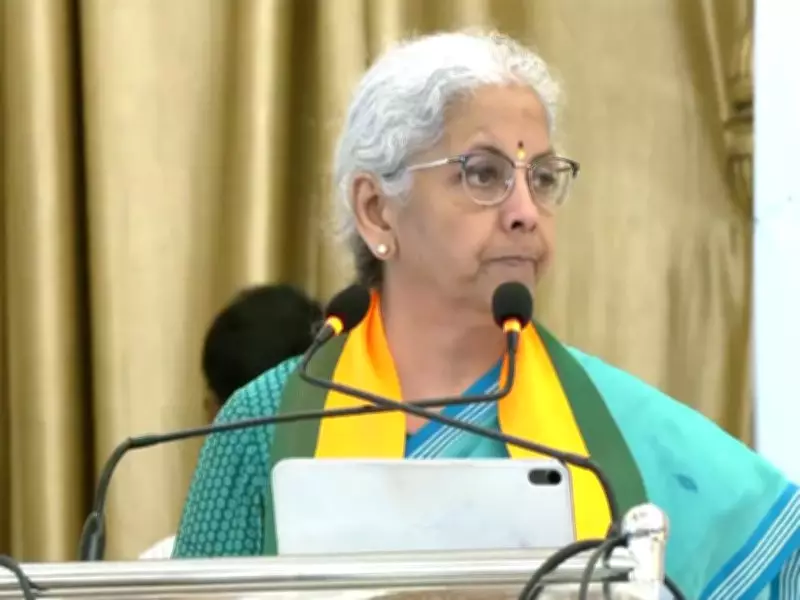
Union Finance Minister Nirmala Sitharaman on Sunday stated that India is facing risks from rising crude oil prices, tensions in West Asia, and potential disruptions at the Strait of Hormuz. However, she emphasized that Prime Minister Narendra Modi's government has successfully ensured no supply disruptions for households or the economy.
Remarks at Viksit Bharat Event
Speaking at the Viksit Bharat event in Bengaluru, Sitharaman outlined India's economic growth story amid geopolitical challenges. She said, "Even with the Middle East crisis, even with straight-up farmers causing a lot of disruption, and someday during my address, I will tell you the nature of risks and challenges. It is not just the cost of crude, it is not just the cost of LPG, it is also the problems that any country faces."
She elaborated on shipping pressures linked to the Hormuz region, noting that liners are unavailable due to safety concerns, insurance premiums have surged, and containers are scarce. Despite these challenges, the Prime Minister is ensuring no supply disruption, reflecting the government's attention to the economy and households.

Economic Growth and Welfare
Sitharaman countered criticism of India's economic performance, stating, "There is no disaster awaiting India. On the contrary, quarter after quarter, year after year, not just we saying that we are the fastest growing, here is the number, GDP growth, you have IMF saying it once in April, May, which is a springtime assessment, and again in October time, we come up with the data to show why India is still the fastest growing economy."
She cited welfare and poverty data, noting that 25 crore Indians have come out of multidimensional poverty, with extreme poverty declining from 29.17% in 2013-14 to 11.28%. Additionally, 12 crore households received toilets, and rural tap water connections rose from 3.23 crore in 2019 to 15.85 crore.
Three Revolutions Reshaping India
The Finance Minister outlined three global-standard revolutions reshaping India. The first is the Digital Public Infrastructure (DPI) revolution, with Bengaluru at its heart. She highlighted the JAM (Jan Dhan-Aadhaar-Mobile) trinity, which has achieved 58 crore Jan Dhan accounts and 144 crore Aadhaar identities. UPI processes 2,100 crore transactions per month, with 86% of person-to-merchant payments below Rs 500, enabling street vendors to use the same digital rail as techies.
The second revolution is 'formalization', with GST registrations jumping from 66.5 lakh in 2017 to 1.64 crore. Furthermore, 31 crore unorganized sector workers registered on the e-Shram portal, and Mudra loans worth Rs 40 lakh crore were sanctioned, 66% of which went to women.
The third revolution is welfare through 'saturation', ensuring every eligible person is covered. She cited 15.85 crore rural tap water connections, 10.5 crore free LPG connections under Ujjwala, and 81 crore citizens receiving free food grains.
Sitharaman concluded that the government is balancing infrastructure with human development despite global headwinds, ensuring both development and welfare while navigating crude and logistics risks.






