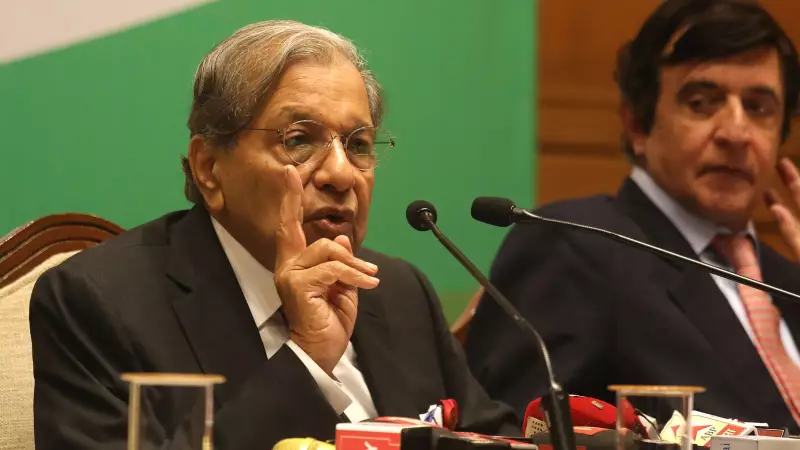
India's ability to attract sustained global investment is critically dependent on maintaining fiscal discipline across the entire "general government" – a term encompassing both the central government and all state governments. This was the central argument put forth by NK Singh, the former chairman of the 15th Finance Commission, during a major economic conference.
The Case for a Unified Fiscal View
Delivering the inaugural address at the 108th annual conference of the Indian Economic Association (IEA) at Hyderabad's Osmania University, Singh emphasized that international investors scrutinize the combined fiscal health of the Centre and states, not just the central exchequer alone. He stated that cooperative federalism, paired with growth driven by enhanced competitiveness, is non-negotiable for sustaining the economy's long-term trajectory.
"Fiscal discipline in a federal polity is never easy, especially one embedded in democracy," Singh remarked. He pointed out that while New Delhi focuses on its own deficit and debt, the investment community looks at the bigger picture. "Investors look at the general government. That is, the Centre and the states taken together. Focusing on general government is the path forward," he asserted.

Aligning Central and State Fiscal Policies
Singh highlighted the need for better alignment between central and state-level fiscal responsibility laws. He cited the example of the Fiscal Responsibility and Budget Management (FRBM) Act. When the first FRBM Act was adopted in 2003, all states eventually enacted their own versions. However, when the central government updated the framework in 2017, most state policies remained unchanged.
"It is therefore important that states are incentivised and cajoled into accepting the 2017 FRBM amendments," Singh explained. He proposed a system of incentives and consequences to mainstream states into a broader fiscal discipline, rewarding prudence and discouraging profligacy. This becomes even more pertinent as Finance Minister Nirmala Sitharaman has indicated that debt will be the principal fiscal anchor for the Centre in the upcoming budget. Singh posed the critical question: "How do we replicate this for the state governments?"
Learning from Global Peers and India's Own Reform History
In a comparative analysis, Singh noted that while India and China had similar economic sizes until 1950, China's per capita income had grown to be roughly 5.5 times that of India by 2023. He clarified that authoritarianism alone does not explain this gap, arguing that democracy and development are not incompatible, as India's recent growth demonstrates.
The key difference, according to him, was in the approach to trade. Nations like China and South Korea treated exports as a fundamental engine for growth, leading to improvements in logistics, skills, and technology. "In sharp contrast, Indian policymakers…treated trade as something to be rationed, not expanded through enhanced competitiveness," he observed.
To boost India's competitiveness, Singh stressed the importance of the cost of land, labour, and capital. He welcomed recent changes in wage frameworks as a step toward aligning labour costs with international practices. Equally crucial, he said, is improving investment productivity, measured by the Incremental Capital Output Ratio (ICOR). India's ICOR has improved from around 5 to about 4.5, but the goal should be to bring it down to around 3 in the medium term.
Singh concluded by recalling India's own reform successes, such as in telecommunications and information technology, where deep policy changes led to exponential growth. He argued that such reformist zeal, applied within a framework of cooperative federal fiscal responsibility, is essential for India's onward march.