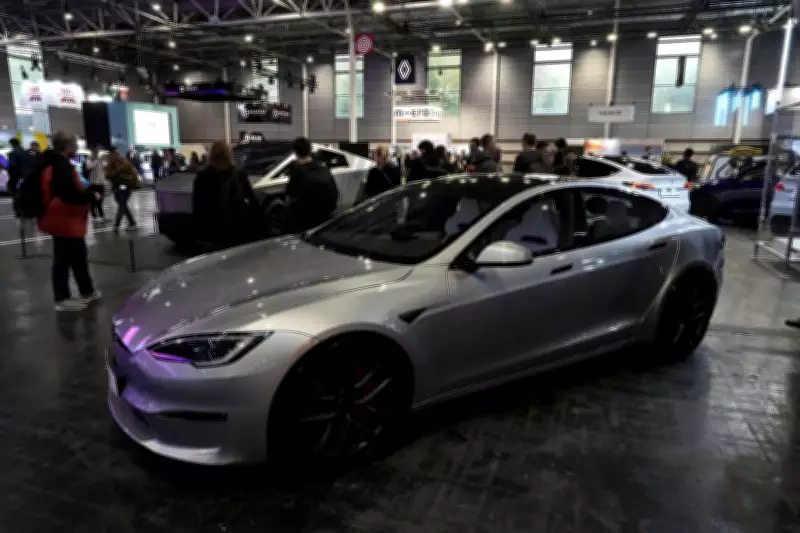
Tesla's annual profit has plummeted to its lowest level since the pandemic five years ago, as the company lost its crown as the world's biggest electric vehicle maker to a Chinese competitor and faced significant sales declines due to boycotts. The electric vehicle firm, led by Elon Musk, reported on Wednesday that net income for the last year dropped a staggering 46 percent to USD 3.8 billion. This marks the second consecutive year of steep profit declines, highlighting ongoing challenges in the competitive EV market.
Strategic Shift Towards Artificial Intelligence
Despite the introduction of more affordable models and Musk's pledge to maintain a laser focus on Tesla after his involvement in U.S. politics, the company's financial performance has suffered. However, Tesla investors have remained steadfast in their support for Musk, with the stock rising 9 percent over the past year. Musk has been actively urging stakeholders to look beyond traditional car sales and envision a future dominated by artificial intelligence.
Ambitious AI and Robotics Plans
During a recent conference call, Musk emphasized this strategic pivot by announcing that Tesla will cease production of its older Model S and Model X vehicles in the second quarter. The Fremont, California factory will be repurposed to manufacture Optimus robots instead. This move underscores Tesla's commitment to transforming its business model from automotive manufacturing to advanced robotics and AI-driven solutions.

Realizing these futuristic ambitions will require substantial financial investment. Company officials revealed that Tesla plans to more than double its capital expenditures to USD 20 billion this year, with significant funds allocated to AI and other innovative projects. Additionally, Tesla disclosed a recent USD 2 billion investment in xAI, an artificial intelligence company known for its Grok AI assistant. This investment raises potential conflicts of interest, as Musk holds substantial stakes in both Tesla and xAI.
Financial Performance and Market Challenges
Tesla's fourth-quarter profit also experienced a sharp decline, falling 61 percent to USD 840 million, or 24 cents per share. Excluding one-time charges, net income totaled 50 cents per share, slightly above analysts' forecasts of 45 cents. Industry experts attribute the downturn to several factors, including aging product lines and increased competition.
"Tesla is grappling with aging products that are becoming less competitive as other manufacturers introduce new models," said Telemetry analyst Sam Abuelsamid. "Moreover, Musk's involvement in politics has alienated some customers, contributing to brand erosion."
Bright Spots in the Report
Despite the overall profit slump, Tesla's earnings report contained some positive indicators. The company's energy storage business, though smaller than its automotive division, posted robust numbers last quarter with revenues surging 25 percent to USD 3.8 billion. This growth reflects rising demand from new data centers across the United States.
Additionally, Tesla's gross profit margins improved significantly, jumping to 20 percent last quarter from 16 percent a year ago. "Tesla's ability to demonstrate improving profitability was a welcome surprise," noted Morningstar analyst Seth Goldstein.
Robotaxi Rollout and Future Prospects
Goldstein also expressed optimism about Tesla's plans to launch a robotaxi service in Houston, Miami, and five other cities during the first half of this year. During the conference call, the company announced it would begin production of its two-seated Cybercab, a vehicle designed without wheels or pedals, within the same timeframe.
However, Musk has a history of missing self-imposed deadlines. For instance, he previously predicted that European regulators would approve Tesla's partial self-driving software in the first three months of last year, a move that could have boosted sales in the region. That approval has yet to materialize. Similarly, a anticipated mid-year sales revival failed to occur.

Challenges and Cautious Progress
The robotaxi program has advanced slowly, with Musk attributing the pace to Tesla's extreme caution in avoiding mishaps. Initially, Tesla promised fully autonomous rides without human drivers, but until recently, safety supervisors were present in the vehicles to take control if needed. The company has now removed these safety drivers in Austin, where the service launched in June.
Despite these hurdles, some Wall Street analysts remain bullish on Tesla's future. Dan Ives of Wedbush Securities, one of the most optimistic analysts, predicts that robotaxis will be operational in over 30 cities by the end of this year. He also forecasts that Tesla will capture 70 percent of the global self-driving car market within a decade.
Musk's Focus and Future Distractions
Analysts are encouraged by Musk's renewed focus on Tesla after spending months leading a government cost-cutting team in Washington. However, it remains uncertain whether his attention will remain undivided in the coming year. Musk has plans to take his rocket company, SpaceX, public, potentially in June. Many anticipate this initial public offering to be a blockbuster event that could make Musk the world's first trillionaire—but it may also divert his attention from Tesla's operations.
As Tesla navigates this critical juncture, balancing its traditional automotive business with ambitious AI and robotics ventures, the company's ability to execute on its promises will be closely watched by investors and industry observers alike.