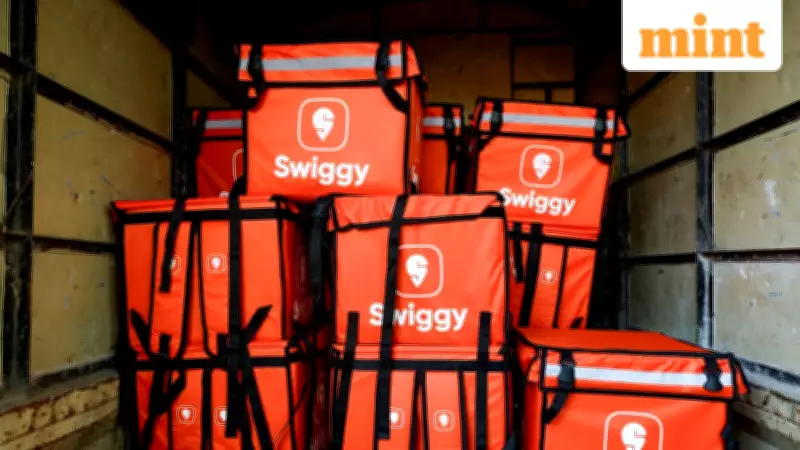
Swiggy's Quick Commerce Arm Instamart Sees Losses Balloon Amid Market Turmoil
Bengaluru-based food delivery giant Swiggy Limited has adopted a cautious stance regarding its quick commerce business, signaling a strategic review of aggressive consumer incentives in the face of cutthroat competition. The company's quick commerce vertical, Instamart, witnessed its adjusted Ebitda losses surge to a staggering ₹908 crore during the December quarter, a significant increase from the ₹578 crore loss recorded in the same period last year.
Strategic Review of 'Limited Success' Investments
This financial setback comes as Swiggy ramped up spending on marketing initiatives and customer-facing experiments like Maxxsaver, alongside expanding its product assortment. However, Sriharsha Majety, Swiggy's Managing Director and Group CEO, revealed in a letter to shareholders that some of these recent investments have yielded only "limited success" and are currently under review.
"Amidst irrational competition, our recent investments into lower consumer-side monetization have not yielded the desired incremental order-growth, especially at the bottom of the AOV (average order value) pyramid, and are being reviewed," Majety stated, highlighting the challenges in driving volume without compromising unit economics.

Volume Growth vs. Sustainable Economics
Despite the widening losses, Instamart demonstrated robust growth in key operational metrics. The gross order value (GOV) more than doubled year-on-year, reaching ₹7,938 crore compared to ₹3,907 crore in the previous year. The platform serviced nearly 106.4 million orders in the December quarter, a substantial increase from 73.2 million orders a year ago.
Monthly transacting users soared by over 80% to 12.8 million in Q3, while the average order value (AOV) improved to ₹746 from ₹534. However, the company emphasized its unwillingness to pursue purely volume-led growth through deep discounting, consciously avoiding "irrational" price wars that could undermine order sizes and long-term profitability.
Intensifying Competitive Landscape
The competitive intensity in India's quick commerce sector escalated dramatically during the December quarter. Major players rolled out aggressive initiatives to attract customers and boost AOVs. While Instamart eliminated handling fees for orders above ₹299, rival Zepto waived handling and surge charges for orders above ₹99 in November.
Reliance Retail's JioMart has emerged as a formidable competitor, fulfilling over 144 million orders in Q3 through its extensive network of 3,000 stores across 1,000 cities. Market leader Blinkit reported fulfilling 243.3 million orders during the same period, underscoring the fierce battle for market share.
Management's Outlook on Sustained Competition
Swiggy's leadership anticipates continued competitive pressure in the quick commerce space. Amitesh Jha, Head of Instamart, told analysts, "We believe that the irrationality [in competition] will continue and have a headwind on our growth."
Majety added, "The category is only 25% done, and we continue to have a very large opportunity to go after. Ultimately, as we have outlined before, playing to win in the long-term will depend on our ability to increase our staying power in a hyper-competitive market."
Rohit Kapoor, Head of Swiggy's Food Delivery Business, expressed confidence in the company's strategy, stating, "We [Swiggy] have lived in competition our entire lives. Our P&L, balance sheet, and strategy are in our control. What others do is not." He believes the market is sufficiently large to accommodate multiple players.
Financial Performance and Food Delivery Strength
Swiggy's overall operating revenue surged by more than 53% to ₹6,148 crore in the third quarter. However, the increased expenses associated with Instamart weighed heavily on the company's bottom line, widening its net losses for the period to ₹1,066 crore from ₹800 crore a year ago.

In contrast, Swiggy's food delivery arm showcased remarkable resilience, posting a 20% year-on-year growth in gross order value (GOV) to ₹8,959 crore in the December quarter—its fastest growth in three years. Adjusted Ebitda for food delivery improved to ₹272 crore from ₹184 crore in the same quarter last year.
Innovation and Future Growth Drivers
Kapoor highlighted that new initiatives such as Bolt, 99-store, and EatRight have achieved product-market fit (PMF), with Bolt and 99-store now accounting for more than a fifth of the firm's food delivery order volumes. "Snacc and Toing are at the pre-PMF stage. We will continue driving investments in platform innovations to the extent that makes sense," he added.
The food delivery business clocked an operating revenue of ₹2,041 crore, up from ₹1,637 crore in the previous year. Swiggy maintained its guidance of 18-20% year-on-year GOV growth in food delivery, reflecting confidence in this segment's continued momentum.
The company's shares closed at ₹323.85 on Thursday, marking a marginal gain of 0.11%, though the stock remains down approximately 25% over the past year, reflecting investor concerns about the quick commerce segment's profitability challenges.