

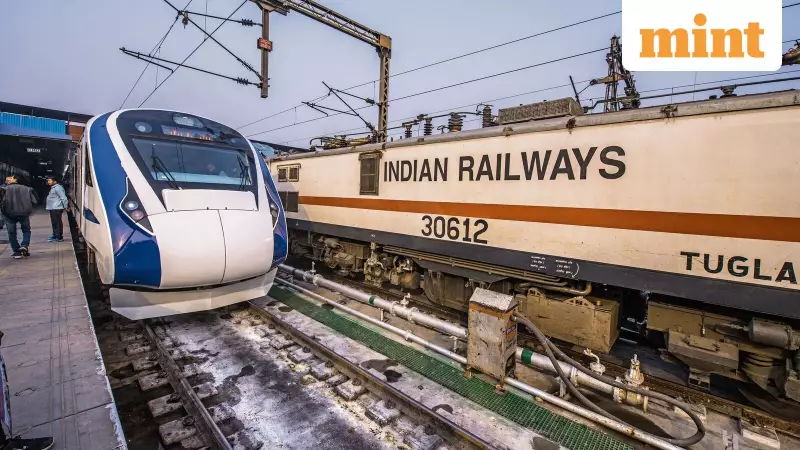
In a move aimed at improving its financial health, Indian Railways has announced a second round of passenger fare increases for the current fiscal year. The revised tariffs, which will see fares rise by one to two paise per kilometre across most classes, will come into effect from 26 December 2024.
Details of the Fare Rationalization
This marks the second fare adjustment by the national transporter since July this year. The ministry stated that this rationalization is intended to streamline tariff structures and enhance the financial sustainability of passenger services, which have historically operated at a loss.
The specific increases are as follows: fares for ordinary second-class non-AC travel will rise by 1 paisa per kilometre. For mail and express non-AC classes, as well as all AC classes, the increase will be 2 paise per kilometre.

However, providing some relief to short-distance travellers, the Railways has decided there will be no change in second-class fares for journeys up to 215 km on ordinary trains. Furthermore, suburban train fares and monthly season tickets will see no increase.
Financial Pressures and Revenue Goals
The ministry explained the hike by citing a significant rise in operational costs. In an official statement, it highlighted that manpower costs have surged to ₹115,000 crore, while pension costs stand at ₹60,000 crore. The total cost of operations for 2024-25 is projected at a staggering ₹263,000 crore.
"To meet this higher cost of manpower, railways are focusing on higher cargo loading and a small amount of passenger fare rationalization," the statement read, emphasizing continued efforts towards efficiency and cost savings.
The fare hike is expected to generate approximately ₹600 crore in additional revenue for the Railways in the remaining period of this fiscal year. This move is also seen as a step to improve the Railways' operating ratio—a key measure of efficiency—which is projected at 98.43% for this fiscal.
Impact on Passengers and Train Services
The practical impact on passengers' wallets will vary by journey length. For instance, a 500 km journey in a non-AC coach will become costlier by ₹10. A longer trip, like Delhi to Mumbai (approx. 1,384 km) in an AC class, will see an increase of about ₹27.68.
The revision applies broadly to all passenger train services. While not explicitly listed by the Railways, this includes premium trains such as:
- Vande Bharat
- Rajdhani and Shatabdi
- Duronto, Tejas, and Humsafar
- Amrit Bharat and Gatimaan
- Antyodaya and Jan Shatabdi
- Yuva Express and AC Vistadome coaches
It is important to note that charges for ancillary services like reservation fees and superfast surcharges remain unchanged. The Goods and Services Tax (GST) will continue to be applied as per existing rules.
The new fares will apply only to tickets booked on or after 26 December. Tickets issued before this date will be honoured at the old fare without any need for adjustment. The last fare increase before this was implemented on 1 July 2024, which was the first hike since the COVID-19 pandemic. Prior to that, fares were revised in January 2020.






