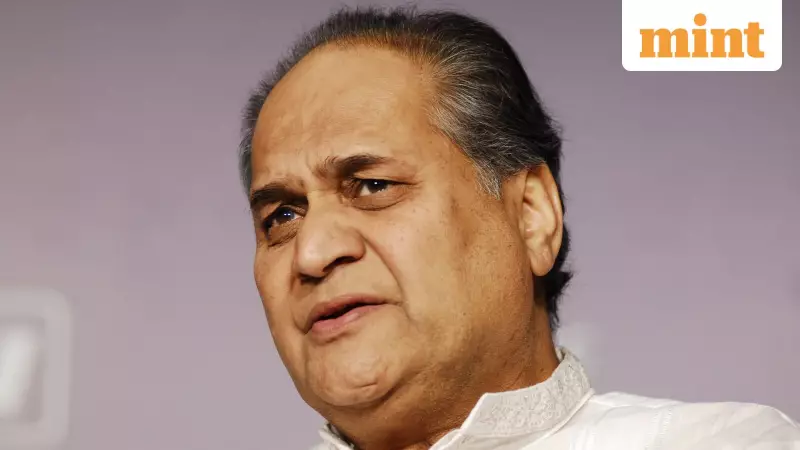
Rahul Bajaj: The Visionary Who Forged India's Industrial Identity
When 27-year-old Rishab Bajaj stepped onto the stage to unveil the electric Chetak C25 earlier this month, the moment resonated with profound historical significance. For the fourth generation of the Bajaj family, this product launch represented more than just another vehicle—it was a powerful connection to a legacy that began with Jamnalal Bajaj in 1926 and was profoundly shaped by Rahul Bajaj's transformative leadership.
The Birth of an Icon: Chetak's Middle-Class Revolution
To truly appreciate Rishab Bajaj's inheritance, one must journey back to 1972 when his grandfather, Rahul Bajaj, introduced the first Chetak scooter. This sturdy, practical vehicle—adapted from the Vespa Sprint—would become the most tangible symbol of Indian middle-class aspirations for decades. For Indians who grew up during the 1970s and 1980s, Hamara Bajaj wasn't just transportation; it was the vehicle that carried families to temples on Sundays, ferried children to examination halls, and represented upward mobility.
Rahul Bajaj's fundamental insight was remarkably straightforward yet revolutionary: Indians needed affordable, reliable personal transportation that could withstand the country's challenging roads, variable mechanical expertise, and complex government price controls. This vision created such demand that waiting lists stretched for years, with families booking scooters at the birth of a child in anticipation of future needs.

Challenging the Licence Raj: A Combative Industrialist Emerges
When Rahul Bajaj assumed control of the family business in 1968, India's economy operated under the suffocating constraints of the Licence Raj. This system required government approval for virtually every business decision, blending Fabian socialism's suspicion of private enterprise with bureaucratic proceduralism. Into this restrictive environment stepped a young man with impeccable credentials—degrees from St. Stephen's College and Bombay University, plus an MBA from Harvard Business School where he earned Baker Scholar distinction.
His professors remembered him as someone who asked uncomfortable questions, a characteristic that would define his entire career. The family business at that time encompassed diverse operations from sugar production to ceiling fans, with the licensed scooter division selling barely 15,000 units annually.
Bajaj's journey faced significant institutional hurdles. Bajaj Auto was summoned before the Monopolies and Restrictive Trade Commission for exceeding licensed production capacity. While a less determined industrialist might have accepted artificial scarcity as profitable, Rahul Bajaj successfully defended his company, won expansion approval, and vocally criticized a system that penalized efficiency.
The Uncompromising Voice of Indian Industry
This combative spirit became Rahul Bajaj's trademark. Over subsequent decades, he gained notoriety for speaking his mind with a candor rarely witnessed in contemporary corporate boardrooms. One particularly memorable moment occurred in November 2019 at an awards ceremony when he directly addressed government representatives: "You are doing good work, but we don't have the confidence that you will appreciate it if we criticize you openly."
Even when his positions appeared contrary to prevailing trends—such as his 1992 leadership of the Bombay Club that protested India's sudden economic liberalization—there remained an undeniable honesty to his stance. What drove this unwavering commitment? Partly his educational background, partly his sense of legacy, but fundamentally a distinctive character that seemed genuinely unconcerned with conventional business anxieties.
Building Institutions That Outlast Their Founders
Rahul Bajaj's personal life reflected his professional principles. He resided within the Bajaj Auto factory complex in Akurdi, Pune, raising his family alongside workers and their families. His elder son, Rajiv, attended the local St. Ursula High School with children from the factory colony, embodying an unusual integration of corporate leadership and community.

Despite his reputation for plain speaking, Bajaj demonstrated remarkable diplomatic skill. In 2008, he resolved a protracted seven-year conflict with his brother Shishir Bajaj regarding the latter's exit from the group. Around this same period, he accomplished what has eluded numerous Indian business families: a smooth division of the empire between his two sons. Rajiv assumed operational control of the two-wheeler business while Sanjiv took leadership of the financial services arm—both enterprises subsequently flourished.
The Enduring Legacy: Reliability Beyond Glamour
Foresight, vision, practical wisdom, and courage—these seemingly simple qualities established Rahul Bajaj as a certified business legend. Eschewing flashy corporate maneuvers, he maintained quiet resolve when competitors diversified recklessly, persisting with focus when others constantly pivoted. His ambition wasn't to become India's wealthiest individual but to manufacture excellent scooters and witness families place their trust in them.
Rahul Bajaj's fundamental insight transcended profit-making: he understood that the industrialist's true responsibility involves building institutions that endure beyond their founders. Today, original Chetak scooters from the 1980s and 1990s still navigate smaller Indian cities, transporting families to markets and being repaired by mechanics who learned their trade during Bajaj's prime. These vehicles remain unglamorous yet utterly dependable—much like the visionary who created them.