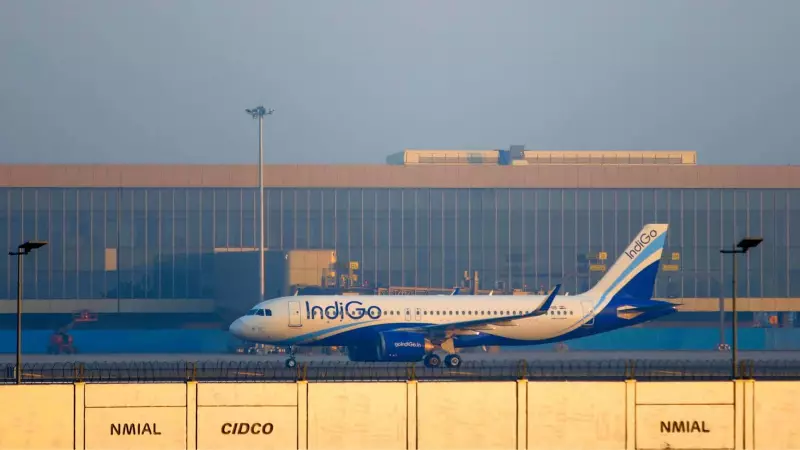
IndiGo's Q3 Profit Nosedives 78% After December Operational Meltdown Inflicts Rs 577 Crore Hit
IndiGo, India's largest airline, has reported a steep decline in its financial performance for the October-December quarter, with consolidated net profit crashing 78% year-on-year to Rs 549 crore from Rs 2,449 crore. This sharp drop is primarily attributed to a one-time exceptional loss of Rs 577 crore resulting from the carrier's severe operational meltdown in early December, which marked its worst crisis in nearly two decades of operations.
Regulatory Penalties and Exceptional Items Weigh Heavily
Alongside the operational disruption costs, another exceptional item—a Rs 969-crore provision for increased social security benefits due to the implementation of new labour codes—further impacted the bottomline. The Rs 577-crore loss includes Rs 555 crore provisioned for operational disruption-related expenses, such as passenger compensation as per regulatory guidelines, travel voucher issuances to most-affected passengers, and other associated costs. Additionally, Rs 22 crore has been set aside for financial penalties imposed by the aviation regulator, Directorate General of Civil Aviation (DGCA).
On January 17, the DGCA slapped IndiGo with financial penalties totalling Rs 22.20 crore for the massive disruption that led to over 2,500 flight cancellations and around 1,850 flight delays between December 3 and 5. This cumulative fine is the highest-ever regulatory penalty imposed by the DGCA on an airline, slightly exceeding IndiGo's average daily net profit for the 2024-25 financial year. The airline was also ordered to pledge a bank guarantee of Rs 50 crore, which will be released in phases after compliance with DGCA directives.

Management Accountability and Root Cause Analysis
The DGCA has issued warnings to senior management personnel, including CEO Pieter Elbers and COO Isidre Porqueras, for the disruption, which was primarily caused by inadequate preparedness for revised pilot rest and duty duration rules. The regulator has directed the airline to relieve Jason Herter, senior vice president of the operations control centre, of current operational responsibilities. A four-member DGCA inquiry committee identified over-optimisation of operations, deficiencies in system software support, and shortcomings in management structure as key causes.
Elbers stated that the airline's board is evaluating the DGCA directions and is committed to taking full cognizance of the orders. IndiGo is conducting its own root-cause analysis with the help of an international aviation expert to address compounding factors and ensure systemic corrections going forward.
Recovery and Future Outlook
Having recovered from the crisis, IndiGo expects its seat capacity to increase by 10% in the March quarter compared to the same period last financial year, predominantly driven by more international flights. However, the airline's approved domestic schedule is curtailed by 10% for the Winter Schedule, ending late March, with current operations at over 2,200 flights—down from 2,300-plus. Elbers mentioned that IndiGo is handing back unused airport slots due to the curtailed schedule, and the Ministry of Civil Aviation has asked other airlines to submit requests for these vacated slots.
IndiGo has assured the DGCA of sufficient pilot availability beyond February 10, when exemptions from new pilot duty rules expire. The airline will have 2,400 captains available for its Airbus A320 fleet against a requirement of 2,280, and 2,240 first officers against a need of 2,050. During the crisis, IndiGo had reported a shortage of 65 A320 captains under the new Flight Duty Time Limitation (FDTL) rules, which include a revised definition of 'night' and a cap on landings for pilots operating red-eye flights.
With a focus on restoring normalcy and preparing for the February transition, IndiGo aims to stabilise operations and mitigate future disruptions through enhanced management and operational controls.