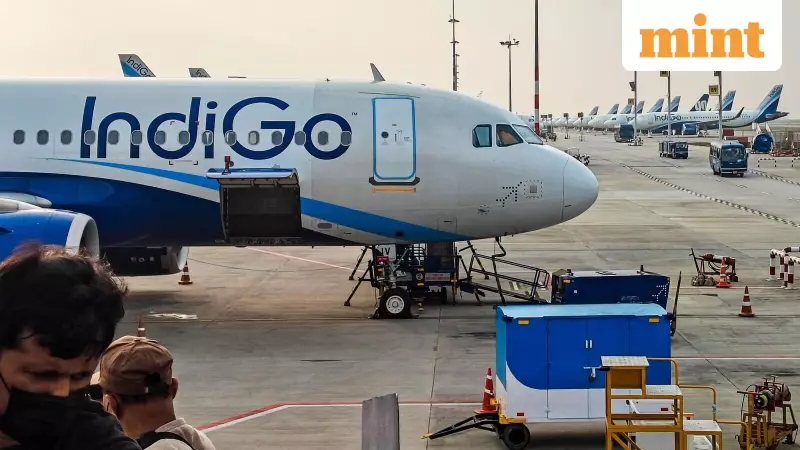
India's largest airline, IndiGo, has significantly scaled back its near-term growth expectations following a challenging October-December quarter that saw its earnings come under severe pressure. The carrier reported a staggering 78% year-on-year decline in consolidated profit, which plummeted to ₹549 crore for the third quarter of fiscal year 2026. This marks the airline's weakest financial performance in four years, casting a shadow over its operational stability.
Exceptional Costs Drive Quarterly Slump
The dramatic profit drop was primarily driven by exceptional costs totaling ₹1,546.5 crore. These costs stemmed from two major factors: the implementation of new labour codes and substantial compensation paid to passengers affected by widespread flight cancellations in December. The new labour codes alone resulted in a ₹970 crore hit for InterGlobe Aviation, the parent company of IndiGo, as they mandate higher retirement benefits for employees.
December Operational Disruptions Take Heavy Toll
In early December, IndiGo faced severe operational disruptions that led to 2,500 flight cancellations over just three days, impacting more than 300,000 passengers. The chaos prompted India's civil aviation regulator to temporarily curb the airline's flight operations, reducing its daily domestic departures by 10% to approximately 2,000 flights. As compensation for these cancellations, IndiGo paid ₹577.2 crore to affected travelers.

The disruptions were partly attributed to poor planning by the airline in complying with new rules that restricted the number of flights pilots could operate at night, which took effect from November 1. Additionally, the airline faced a 17% sequential increase in fuel costs during the December quarter, with fuel typically accounting for about one-third of an airline's total expenses.
Revised Growth Guidance Reflects Ongoing Challenges
As a direct consequence of the operational curbs, IndiGo has lowered its revenue growth target for the current fiscal quarter. The company now expects available seat kilometer growth to be in the "single digits," a significant reduction from the "high teens" growth guidance provided at the end of the second quarter. This downward revision reflects the ongoing challenges facing the aviation giant.
"This curtailment will have an effect on the March quarter," stated IndiGo's CEO Pieter Elbers during a post-earnings call. He noted that while October and November had started well, the operational disruptions in December significantly impacted performance. However, Elbers expressed optimism about the future, saying operations have stabilized in January and are expected to remain stable in February, adding, "We continue on our growth path."
Management Maintains Cautious Optimism
Despite the disappointing numbers, IndiGo's top management remains cautiously positive about the normalization of operations and visible headwinds. Chief Financial Officer Gaurav Negi acknowledged that "effects of the headwinds continue to grow on us," noting that passenger revenue growth in the March quarter is expected to remain in the "mid to single digits." This projection comes as the company compares against a high base from the previous year, driven by increased travel during the Kumbh Mela.
Revenue Growth Amid Profit Decline
Interestingly, despite the profit plunge, IndiGo's revenue from operations showed resilience, rising 26.5% sequentially and 6.2% from the year-ago period to ₹23,472 crore. For the first nine months of the current fiscal year, the airline has recorded a 6% increase in revenue to ₹62,523.5 crore. In the year ended March 2025, its total revenue reached ₹80,802.9 crore, demonstrating the underlying strength of its business model.
Analysts Give Thumbs-Up to Results
Aviation analysts have largely given a positive assessment of IndiGo's quarterly performance. Gagan Dixit, Aviation analyst at Elara Securities, remarked, "IndiGo's numbers are better than expected for the December quarter. There are one-time hits. Overall, there is no long-term impact on its operational metrics."

Karan Khanna, lead analyst at Ambit Capital covering hotels, real estate, aviation, and small & mid caps, concurred, stating, "Results were largely in line with street expectations except for one-offs. However, profitability for the December quarter was impacted by exceptional items, primarily due to forex losses, adjustments related to the new labour code and operational disruptions experienced in December."
Khanna further noted that the company has lowered its guidance for the fourth quarter and has not yet provided any indication regarding fiscal year 2027. He added, "Looking ahead, the fourth quarter is also expected to face pressure from rupee depreciation. As a result, Q4 earnings are unlikely to deliver any positive material surprise versus market expectations."
Market Reaction and Industry Context
Shares of InterGlobe Aviation ended 1.15% higher on the BSE on Thursday, outperforming the Sensex which closed up 0.49% at 82,307.3 points. The airline announced its earnings after market hours, suggesting investor confidence may have been bolstered by the underlying revenue growth despite the profit decline.
The turbulence faced by IndiGo comes at a challenging time for the Indian aviation sector. Its closest competitor, privately held Air India, is also struggling to turn profitable amid operational challenges. The Tata-owned airline is reportedly seeking a successor to incumbent CEO Campbell Wilson, whose efforts have been hampered by airspace closures resulting from tensions between India and Pakistan.
Meanwhile, SpiceJet, the fourth-largest carrier, remains the other listed airline in India, while Akasa Air operates as a privately owned competitor. The entire industry continues to navigate a complex landscape of regulatory changes, operational challenges, and economic pressures that test even the most established players.