

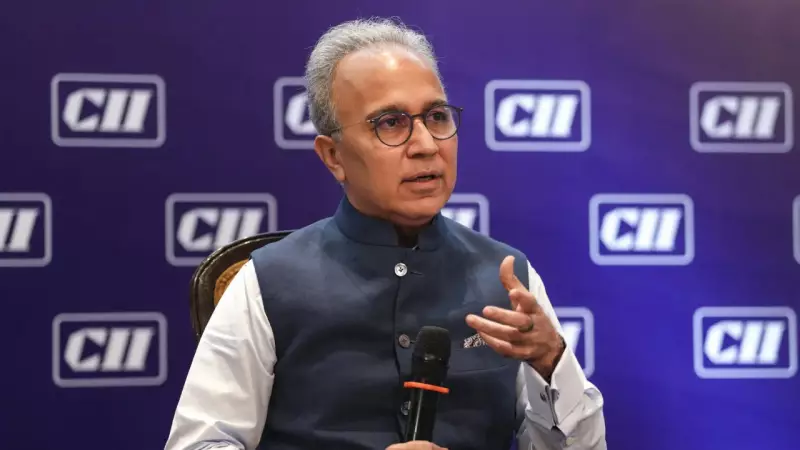
Rajiv Memani, the President of the Confederation of Indian Industry (CII) and Chairman & CEO of EY India, has described the current period as a remarkable year for reforms and emphasized the critical need to maintain this momentum into 2025. In a detailed interview, he pinpointed power, mining, ease of doing business, and judicial reforms as pivotal focus areas for the government to accelerate India's economic growth.
A Strong Foundation and the Road Ahead
Memani highlighted that against a challenging global backdrop, India's achievement of 8% GDP growth in the first half of the year is exceptional. He noted that other macroeconomic indicators, including fiscal deficit and corporate health, are also robust. This positive environment, he argued, has been fueled by a series of reforms ranging from the Budget and GST tweaks to new labour codes and a flurry of trade agreements.
Looking forward, Memani presented a sector-wise wishlist from CII's membership, broadly categorized into factor reforms and ease of doing business. On factor reforms, energy and mining are top priorities. He pointed out that while energy costs have decreased, industries still pay a premium of at least Rs 1.50 per unit due to cross-subsidization and access charges, with state distribution companies (discoms) continuing to incur losses. "There is a need for aggressive privatisation of discoms," he stated.

Similarly, unlocking stranded mining assets could significantly reduce manufacturing costs. In logistics, large investments in high-speed rail networks are essential. Memani also provided a strategic analysis of India's imports, noting that of the $725 billion in annual imports, about $250-300 billion is in difficult-to-substitute items like energy and fertilisers. However, $300-400 billion worth of imports present a viable opportunity for domestic manufacturing.
Streamlining Business and Resolving Disputes
On ease of doing business, Memani advocated for building on the digitization of land records by exploring tokenization. He singled out judicial reforms as a major area of concern, warning that the pile-up of unresolved cases could choke economic growth unless addressed systematically.
Regarding taxation, his recommendations focus on simplification and dispute resolution. He identified mergers, demergers, and acquisitions as key pain points needing clearer rules. Furthermore, with 85% of tax cases stuck at the Commissioner of Income Tax (Appeals) level, a more efficient mechanism is urgently required. He also welcomed discussions on reducing the number of customs duty slabs.
Activating Disinvestment and Building Strategic Capacity
Addressing the slowdown in disinvestment, Memani set an ambitious target. "Over the next two years, we should be looking at over Rs 2 lakh crore of disinvestments or privatisation," he said. The proceeds could create cash reserves for productive economic use, such as infrastructure development.
He also proposed a consolidated approach to manage strategic resources and fund new-age sectors. Given global uncertainties, he suggested that the government consider consolidating efforts in manufacturing, acquiring strategic resources like rare earths, and funding areas such as aerospace, defence, and medical devices into a single ministry or central body for faster execution. "What we have today is not working efficiently," he remarked, also proposing the onboarding of fund management experts to potentially create a fund-of-funds structure.
Industry's Preparedness and External Challenges
On the implementation of new labour codes, Memani said companies are preparing, but a lot depends on state-level execution. He outlined four key needs:

- A digital portal for all states to handle compliances.
- Comprehensive training for inspectors and officials.
- Consistency between state recommendations and the central codes.
- Clarity on whether the codes will be applied retrospectively or prospectively.
Commenting on the impact of US tariffs, Memani noted that while India's overall goods exports have remained resilient, the composition has shifted. Trade diversification, especially in food products and shrimps, is working well. However, some labour-intensive sectors have been impacted. He observed that businesses are striving to sustain existing contracts, as building new relationships in this environment is challenging.
In conclusion, Rajiv Memani's message is clear: the reform momentum of the past year has positioned India strongly, but a focused push on long-pending structural reforms is crucial to unlock the next phase of growth and capitalize on global opportunities.





