

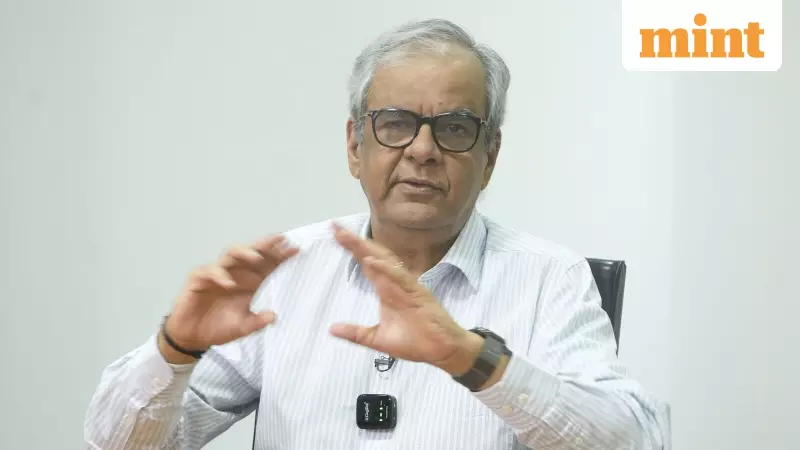
In a market where peers are rushing to list their financial subsidiaries, Kotak Mahindra Bank Ltd is charting a different course. The bank's managing director and chief executive officer, Ashok Vaswani, has articulated a clear stance against taking the group's subsidiaries public, emphasizing a long-term vision over short-term gains from selling stakes to foreign investors.
The Core Philosophy: Building a Lasting Franchise
Ashok Vaswani, who will complete two years leading India's fourth-largest private lender by assets in January 2026, provided his reasoning in a recent interview. He questioned the fundamental value gained by selling stakes to overseas investors who bring neither talent nor brand to the table, yet often reap significant profits years later. "We are not here for a day in the sun or a quarter in the sun; we are here to build a lasting, lasting, lasting franchise," Vaswani stated.
This philosophy stands in stark contrast to the actions of rival banks. ICICI Bank Ltd recently listed its asset management arm in a $1.2-billion IPO, while HDFC Bank Ltd took its non-banking financial arm, HDB Financial Services, public in July 2025. The State Bank of India has also announced plans to list SBI Funds Management. These moves come during a record surge in India's IPO market, which has seen offerings reach a historic high of ₹1.77 trillion as of early December 2025.

Kotak's Conglomerate Structure and Strategic Acquisitions
Kotak Mahindra Bank operates as a full holding company, owning 100% of its 20 subsidiaries across the financial services spectrum. It also holds significant stakes in three associate companies: Infina Finance Pvt Ltd (49.99%), Phoenix ARC Pvt Ltd (49.9%), and Zurich Kotak General Insurance Company (India) Ltd. While Vaswani is generally against bringing foreign partners into subsidiaries, the bank did sell a 70% stake in its general insurance unit to Zurich Insurance Company Ltd in June 2024 for ₹5,560 crore, retaining a 30% share.
Vaswani likens the Kotak group to a multi-engine plane. "There is obviously the banking engine or, let's say, the lending engine. There is the insurance engine, there is the asset management engine and the capital markets. And if I can keep all of this kind of flying along, it gives a lot of insurance," he explained. This diversified model, he argues, ensures stability even if one business segment faces headwinds.
Beyond organic growth, the bank actively pursues strategic inorganic opportunities. In March 2024, it acquired microfinance company Sonata Finance for ₹537 crore, and in January 2024, it purchased Standard Chartered Bank’s personal loan portfolio worth ₹3,330 crore. Vaswani emphasized that any acquisition must provide strategic value—such as new customers, deposits, or portfolio depth—and meet valuation expectations.
Analyst Concerns: IDBI Bank and Capital Efficiency
Kotak Mahindra Bank is often mentioned as a potential contender for IDBI Bank. However, Vaswani declined to comment specifically on IDBI, reiterating his general acquisition criteria. Analysts have expressed caution regarding such a move. Suresh Ganapathy of Macquarie Capital warned that acquiring a stake in IDBI Bank could be a "de-rating event" for Kotak.
Another point of discussion among analysts is the bank's high capital adequacy ratio, which stood at 22.8% as of September 2025—far above the Reserve Bank of India's 11.5% mandate. This surplus capital has suppressed the bank's return on equity (RoE), which declined to 10.65% in the second quarter of FY26 from 13.88% a year earlier.
Vaswani defended the bank's capital position, stating that excess capital provides a buffer against economic downturns and enables the bank to seize growth opportunities. He attributed the lower RoE partly to credit costs and expressed confidence that improvements in operational efficiency through automation and digitization would help boost returns in the future.
As India's financial landscape evolves, Kotak Mahindra Bank, under Vaswani's leadership, is firmly committing to a path of controlled, long-term value creation within its conglomerate model, resisting the prevailing trend of subsidiary listings for immediate monetization.






