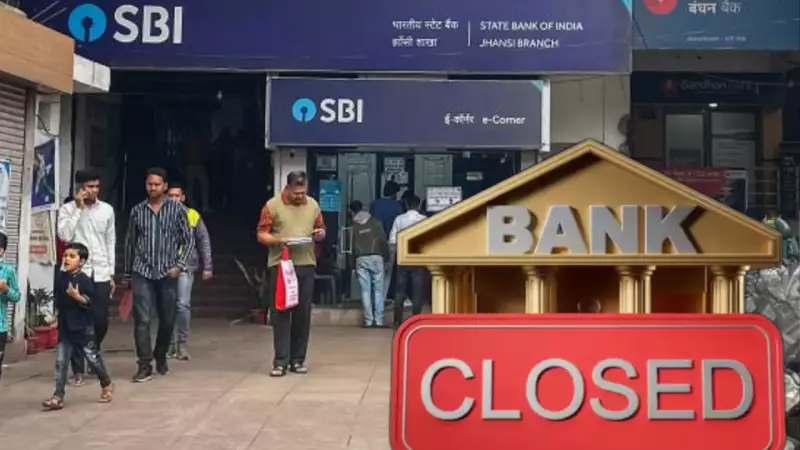
Nationwide Bank Strike Disrupts Public Sector Banking Operations
Banking services across India's public sector banks experienced widespread disruption on Tuesday as the United Forum of Bank Unions proceeded with a nationwide strike. The industrial action comes in response to unions' persistent demand for the immediate implementation of a five-day work week, a long-standing request that has yet to receive formal government approval.
Extended Service Disruption Across Banking Network
The strike action is expected to affect branch-level services for five consecutive days, creating an extended period of operational challenges. This disruption period coincides with existing bank holidays on January 23 for Basant Panchami, January 24 as the fourth Saturday of the month, January 25 being Sunday, and January 26 marking Republic Day celebrations across the nation.
The United Forum of Bank Unions, representing nine major unions of bank officers and employees, had engaged in conciliation meetings with the chief labour commissioner on January 22 and 23. However, union leaders reported that these discussions failed to provide any concrete assurance regarding their primary demands.

Union Leadership Explains Strike Decision
C H Venkatachalam, general secretary of the All India Bank Employees Association and a key UFBU constituent, explained the situation to PTI: "Despite detailed discussions during the conciliation proceedings, there was no assurance on our demand. Hence, we have been compelled to proceed with the strike action."
Union representatives emphasized that the strike aims not to inconvenience customers but to advocate for what they describe as a more humane and sustainable banking system. L Chandrasekhar, general secretary of NCBE, articulated this perspective: "This movement is not against customers, but for a sustainable, humane, and efficient banking system. A rested banker serves the nation better."

Key Aspects of the Banking Strike
- Striking Parties: The industrial action has been called by the United Forum of Bank Unions, comprising nine major unions representing officers and employees of public sector banks.
- Primary Demand: Unions are demanding implementation of a five-day work week, which would designate all Saturdays as holidays in public sector banking institutions.
- Background Context: Reports indicate that the proposal for Saturday holidays was agreed upon during the 12th Bipartite Settlement with the Indian Banks' Association in March 2024, but the necessary government notification remains pending.
- Service Impact: Branch-level operations including cash deposits, withdrawals, cheque clearances, and administrative work face disruption at major public sector banks such as State Bank of India, Punjab National Bank, and Bank of Baroda.
- Private Bank Status: Major private sector institutions including HDFC Bank, ICICI Bank, and Axis Bank are expected to remain largely unaffected since their employees do not participate in the striking unions.
- Digital Banking Continuity: Digital services including UPI transactions, internet banking, and mobile banking platforms will continue functioning, though ATM cash availability may experience localized delays due to logistical challenges.
- Government Preparations: An urgent meeting chaired by the secretary of the department of financial services was conducted with SBI officials, managing directors of nationalized banks, and the IBA CEO to ensure smooth operations of government transactions and business correspondent services.
- Precautionary Measures: Banking authorities have confirmed that ATMs have been loaded with sufficient cash reserves, with timely replenishment arrangements established to minimize customer inconvenience.
- Official Communications: Several public sector banks, including State Bank of India, have formally informed stock exchanges about the strike action. SBI stated in an official communication: "While the bank has made necessary arrangements to ensure normal functioning in its branches and offices on the day of strike, it is likely that work may be impacted."
- Customer Advisory: Banking customers are advised to utilize digital channels for routine transactions while anticipating potential delays in branch-based services throughout the strike period.
Broader Implications for Banking Sector
The ongoing strike highlights deeper structural questions about work-life balance in India's banking sector and the implementation of previously negotiated agreements. As digital transformation continues to reshape banking services, this industrial action brings attention to the human resource challenges facing traditional banking institutions.
The extended disruption period, combining strike days with scheduled holidays, creates an unusual five-day gap in regular branch operations, testing both customer adaptation to digital alternatives and the resilience of banking infrastructure during prolonged service interruptions.