Bharti Airtel Approaches DoT for AGR Dues Reassessment Following Vodafone Idea Precedent
In a significant development within India's telecommunications sector, Bharti Airtel has formally approached the Department of Telecommunications (DoT) seeking a recalculation of its adjusted gross revenue (AGR) dues. This move comes as the government begins reassessing the AGR liabilities of Vodafone Idea, setting a potential precedent for other operators.
Mittal Advocates for Mathematical Corrections Over Legal Battles
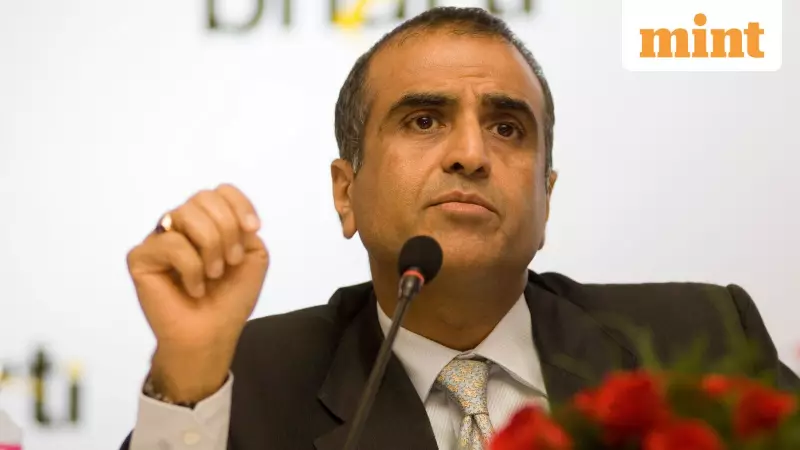
Sunil Bharti Mittal, founder and chairman of Bharti Enterprises, revealed the company's stance during an interaction with CNBC-TV18 on the sidelines of the World Economic Forum in Davos. "From our own standpoint, we are hoping and written to the government that AGR was our issue as well and we hope we get attention from the government," Mittal stated.
He emphasized that Airtel's request focuses on mathematical corrections rather than legal arguments. "It is not a legal point, but a mathematical point and correction of errors," Mittal explained, adding that the company is currently engaged with the government rather than pursuing legal routes.

Government's AGR Reassessment Framework
The backdrop to Airtel's request involves several key developments:
- The Union Cabinet recently froze Vodafone Idea's AGR dues at ₹87,695 crore as of December 31, 2025
- Approved a payment plan allowing clearance between FY32 and FY41
- DoT began reassessing Vodafone Idea's AGR dues for FY07 to FY19 last week
- Supreme Court rulings in October and November permitted government reassessment
Mittal noted that while Airtel hasn't received a government response yet, he referenced Communications Minister Ashwini Vaishnaw's recent statement about following Vodafone Idea's court-directed route. "We heard from the minister yesterday that everybody needs to follow the route that Vodafone Idea followed which is via the (Supreme) Court," he said.
Potential Impact of Reassessment on Airtel's Liabilities
According to Bharti Airtel's FY25 annual report, the company's deferred payment liability towards AGR stands at ₹38,604 crore. Mittal explained how reassessment could significantly reduce this amount:
- Checking payments made by operators that haven't been properly counted
- Identifying and correcting instances of double billing
- Reducing the base principal amount
- Creating a cascading effect on penalties and interest calculations
"If all that is established, your base principal goes down and then there is the cascading effect on penalty, interest on penalty and the amount can come down significantly," Mittal elaborated. He stressed that Airtel isn't seeking concessions but rather accurate calculations: "We are saying take what is due. We are not asking for any concession. But don't take more than what is due."
Market Dynamics and Competitive Landscape
The Indian telecom market continues to evolve with distinct competitive positions:
- Reliance Jio leads with 41.4% subscriber market share
- Bharti Airtel follows with 33.6% market share
- Vodafone Idea maintains 17% share as of November end
Mittal expressed hope that Vodafone Idea would become more active following its relief package, advocating for a "three-plus-one" market structure that maintains healthy competition from a customer perspective.
Tariff Repair and Revenue Growth Imperatives
Bharti Airtel currently leads the sector with an average revenue per user (ARPU) of ₹256 monthly as of September-end. Mittal emphasized the industry's consensus on tariff increases: "Everyone agrees that tariff repair is absolutely essential. There is no one, including the government, who believes that you can have a very robust, solid infrastructure supporting the digital dreams of India without regular investments."

The company aims to reach ₹300 ARPU, with Mittal noting substantial annual investments in networks and spectrum. This contrasts with market leader Reliance Jio's recent statement ruling out immediate tariff hikes, despite its lower ARPU of ₹213.7 as of December end.
African Operations and Growth Prospects
In Africa, Airtel stands as the second-largest telecom operator with 173.8 million subscribers as of September-end. While currency depreciation across several African markets has impacted earnings, Mittal remains optimistic about growth prospects.
"If currency remains in secular depreciation mode, which is 3-4% a year, I think Airtel Africa could get to a $10 billion revenue," he projected, noting that without sharp currency depreciation, revenues could have reached $17-18 billion. Africa represents one of the world's fastest-growing telecom markets, expanding at over 20% annually.
Capital Expenditure and Technological Expansion
Airtel maintains aggressive capital expenditure of approximately ₹30,000 crore annually, with investments shifting across technologies. As 4G spending slows, resources move toward 5G deployment, fibre networks, fixed wireless access, and data centers.
"I would say a little more than (₹30,000 crore) than less than (₹30,000 crore) will be the order of magnitude (for capex)," Mittal stated, while noting that 6G standards remain several years away from implementation.
Infrastructure Access Challenges
Mittal addressed ongoing disputes over mobile connectivity at infrastructure projects like the Navi Mumbai International Airport and Mumbai Metro's Aqua Line. He expressed confidence that these issues would be resolved, citing the Indian Telegraph Act's provisions for right of way access.
"In the end, customers have to be served everywhere," he emphasized, while acknowledging the need for fair compensation to infrastructure providers. Mittal expressed concern about third-party operators charging excessive fees that ultimately affect customer service quality.
Satellite Communications Strategy
Regarding Airtel's satellite communications venture through Eutelsat OneWeb, Mittal revealed that allocated capacity for India could generate approximately ₹200 crore in revenue. The company will focus exclusively on enterprise services rather than consumer markets.
"Our whole constellation is designed for enterprise services—Aero, maritime, defence, security needs of the nation," he explained, distinguishing Airtel's approach from competitors like Starlink and Amazon LEO. Services await final regulatory clearances before rollout.
The comprehensive approach outlined by Mittal reflects Airtel's multi-faceted strategy addressing regulatory challenges, market competition, technological evolution, and international expansion while maintaining focus on sustainable business growth and customer service excellence.