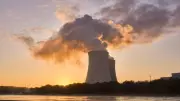
India's Nuclear Push: Light Water Reactors for Global Markets
India's Department of Atomic Energy accelerates work on indigenous Light Water Reactors to tap global markets while maintaining heavy water reactor expertise for strategic advantage.

India's Department of Atomic Energy accelerates work on indigenous Light Water Reactors to tap global markets while maintaining heavy water reactor expertise for strategic advantage.

NPCIL has started online registration for 114 technical and administrative posts at Tarapur Atomic Power Station. Apply by February 4, 2026, through the official portal.

Test your UPSC Prelims 2026 preparation with this Science & Technology quiz covering atomic clocks, Kudankulam plant, rogue planets, and more. Check answers and explanations.
NPCIL has released a notification for 114 technical and administrative posts at Tarapur Atomic Power Station, Maharashtra. Apply online from Jan 15 to Feb 4, 2026. Check eligibility now!

A major renewable energy expo has begun in Chandigarh, featuring 50+ exhibitors and focusing on solar, wind, and green hydrogen solutions for a sustainable future. Explore the innovations!

TERI's Institute of Energy Transition gains formal govt support & a Rs 5 Cr/year MoU with BEE for a Hyderabad-based Centre of Excellence, aiming to lead India's clean energy shift.

Jharkhand CM Hemant Soren announces a committee to identify families of 1948 Kharsawan police firing martyrs, aiming to honour them before 2027 Shaheed Diwas.
Jharkhand CM Hemant Soren announced a committee to identify and honour families of those killed in the 1948 Kharsawan police firing. The state aims to complete the process before January 1, 2027.

Octopus Energy reports a £255 million annual loss due to Bulb Energy acquisition costs and reduced gas demand. Read about the UK energy giant's financial challenges.

The iconic baggy green cap worn by Sir Donald Bradman in his final Ashes series is set for auction. This historic cricket memorabilia could sell for over ₹1.5 crore. Discover the story behind this legendary piece.

India's renewable energy sector added a record 44.5 GW in 2025, led by solar power. Total capacity now stands at 254 GW. Discover the key drivers and state-wise leaders.

Kraken Technologies, a key software platform for managing the clean energy transition, raises $1 billion, achieving an $8.65 billion valuation. Learn how this impacts global utilities and India's green shift.

Kerala Labour Minister V Sivankutty directs a draft notification for revised minimum wages in private hospitals to be published within 30 days, citing stalled talks. A 60% hike from 2013 levels is proposed.

India's SHANTI Act ends state monopoly on nuclear energy, inviting private investment. Learn about the liability reforms, pricing debates, and the road ahead for clean energy goals. Read more.

IIT Delhi researchers create AILA, an AI that autonomously operates lab instruments like the Atomic Force Microscope, cutting experiment time from a day to minutes. A paradigm shift for scientific research.

A windstorm in Colorado knocked out power at a key US lab, causing the nation's official time to lag by 4.8 microseconds. Discover how extreme weather can disrupt our hyper-precise atomic clocks.

India's Parliament passed the SHANTI Bill, allowing private firms in nuclear energy and repealing old acts. This move is crucial for advancing the Indo-US trade deal. Read the full analysis.

IIT Delhi researchers create AILA, an autonomous AI agent that conducts real scientific experiments. It slashes experiment time from a full day to just minutes, marking a major leap for Indian science in energy and materials research. Read more!
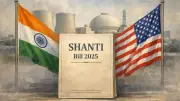
The United States welcomes India's SHANTI Bill, calling it a pivotal step for energy security and peaceful nuclear cooperation. Discover how this transforms bilateral ties.

ISRO conducts critical parachute tests for Gaganyaan, political funding via trusts triples post-electoral bonds, and the legacy of India's first Atomic Energy Act. Essential reading for UPSC aspirants.

Congress MP Manish Tewari raises alarm over India's new nuclear liability law, warning it protects suppliers and threatens regulatory independence. Read the full analysis.

India's new SHANTI Bill raises concerns over nuclear supplier liability and AERB autonomy as the sector opens to private players. Read the full analysis.
India's new SHANTI Bill allows private investment in nuclear energy and limits supplier liability for accidents. Learn about the policy shift and its implications for India's energy future.
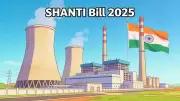
India's Lok Sabha approves the SHANTI Bill 2025, enabling private sector participation in civil nuclear energy to boost capacity and modernize safety regulations. Read the key changes.

India's proposed Shanti Bill 2025 allows private sector into nuclear energy but leaves critical accident liability questions unanswered. Read the full analysis of the bill's implications.
India's new SHANTI Bill transforms nuclear governance, embeds lifecycle safety in law, and allows private participation to meet clean energy targets by 2047. Read the full analysis.

India's Parliament has passed the landmark SHANTI Atomic Energy Bill, 2025. PM Modi calls it a game-changer for technology and clean energy. Read the full details here.

India's Parliament has passed a key bill to allow public sector companies to partner with NPCIL for nuclear power projects, aiming to boost clean energy capacity. Read more.

India's new SHANTI Bill opens the nuclear value chain to private capital, aiming for 22.5 GW by 2032 and 100 GW by 2047 to boost energy security. Read more.

The Lok Sabha has passed a landmark bill allowing private sector participation in India's nuclear energy sector, aiming to boost clean power generation and meet climate goals. Read the full story.