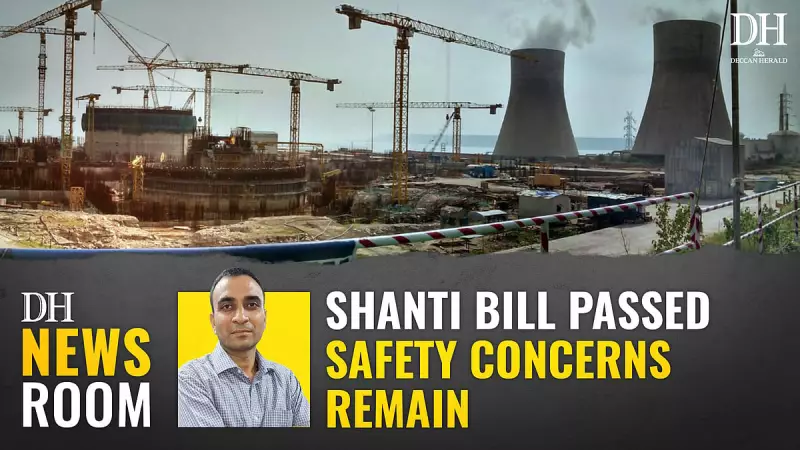
The Indian government has introduced a landmark piece of legislation, the Shanti Bill 2025, which promises to reshape the country's nuclear energy landscape. The bill, officially named 'The Shanti (Peaceful Uses of Nuclear Energy) Bill, 2025', was tabled in Parliament on February 10, 2025. Its primary objective is to open the doors for private sector participation in nuclear power generation, a domain long held exclusively by the state-owned Nuclear Power Corporation of India Limited (NPCIL). However, the proposed law has sparked significant debate as it appears to sidestep the crucial issue of liability in the event of a nuclear accident.
Key Provisions and the Private Sector Push
The Shanti Bill 2025 seeks to amend the six-decade-old Atomic Energy Act of 1962. The most transformative change it proposes is the creation of a licensing framework that would allow private companies to build and operate nuclear power plants. This move is seen as a strategic effort to attract much-needed capital and technological expertise to accelerate India's nuclear power capacity, which is vital for meeting the nation's growing energy demands and climate commitments.
The bill empowers the central government to issue licenses to private entities for activities ranging from the mining of atomic minerals to the production, acquisition, use, and disposal of nuclear material. It establishes a new regulatory body, the Nuclear Energy Regulatory Board, which will be responsible for overseeing safety and issuing these licenses. The government has emphasized that this step is crucial for boosting clean energy output and reducing dependency on fossil fuels.

The Glaring Omission: Accident Liability
While the bill charts a new course for private investment, it remains conspicuously silent on the critical matter of liability for a nuclear incident. This omission creates a legal grey area, as the existing framework—the Civil Liability for Nuclear Damage Act (CLNDA) of 2010—remains in force. The CLNDA, passed in the aftermath of the Chernobyl disaster, holds the plant operator primarily and absolutely liable for damages in case of an accident.
Legal experts and opposition parties have raised alarms. The concern is that the Shanti Bill does not clarify how liability will be apportioned when a private company, not the state-owned NPCIL, is the operator. Critics argue that the bill's silence effectively transfers the massive financial risk of a nuclear accident to the government and taxpayers, while private players reap the profits during normal operations. This could potentially violate the "polluter pays" principle enshrined in the CLNDA.
Reactions and Potential Implications
The introduction of the bill has elicited mixed reactions. Industry bodies have welcomed the move as a progressive step that can unlock significant investment and foster innovation in the nuclear sector. They view it as essential for India to achieve its ambitious target of tripling its nuclear power capacity.
However, opposition leaders and civil society groups have criticized the legislation as being "half-baked" and "dangerous." They demand that the liability clause be explicitly addressed within the Shanti Bill itself to ensure accountability. There are also concerns about the transparency and oversight of the proposed Nuclear Energy Regulatory Board, with calls for it to be an independent statutory authority free from government influence.
The bill's future now hinges on parliamentary scrutiny. It is likely to be referred to a standing committee for detailed examination, where stakeholders will push for amendments to clarify the liability regime. The final shape of the Shanti Bill 2025 will determine whether India's nuclear expansion is built on a foundation of robust safety and clear accountability, or on a risky partnership where ultimate responsibility remains ambiguous.
As the debate unfolds, the world watches to see how India navigates the complex interplay between attracting private investment in a high-stakes industry and upholding its commitment to public safety and environmental responsibility.