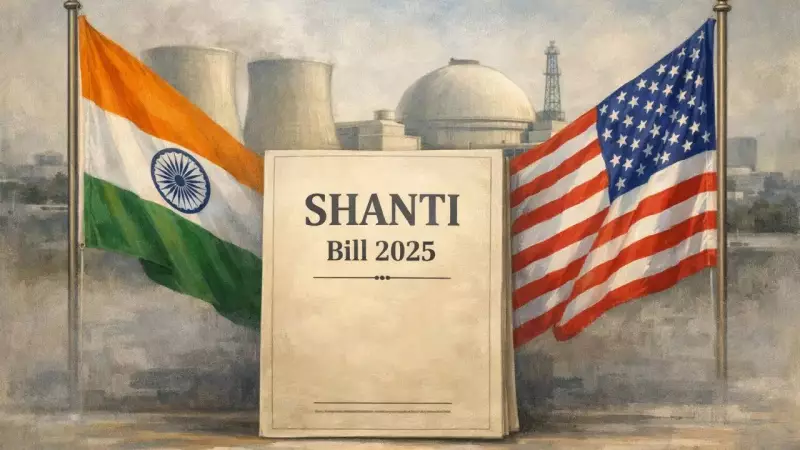
The United States government has officially welcomed the passage of India's landmark SHANTI Bill, describing it as a significant move that will strengthen energy partnerships and peaceful civil nuclear collaboration between the two democracies.
US Endorsement and Strategic Partnership
In a clear endorsement of India's new legislative framework, the US Embassy in New Delhi took to social media platform X to express its support. The embassy stated that it views the Sustainable Harnessing and Advancement of Nuclear Energy for Transforming India (SHANTI) Bill, 2025 as a crucial development that bolsters energy security and paves the way for deeper bilateral cooperation. "We welcome India’s new Shanti bill, a step towards a stronger energy security partnership and peaceful civil nuclear cooperation," the post read. It further emphasized Washington's readiness to collaborate with New Delhi on joint innovation and research and development within the energy sector.
This supportive statement was issued on Monday, just one day after the President of India gave his assent to the bill. The SHANTI legislation marks a major transformation in India's civil nuclear policy, which had remained largely static since the Atomic Energy Act of 1962. The bill was passed by a voice vote in Parliament during the recent winter session, albeit amid a walkout by most opposition members.

Decades in the Making: The India-US Nuclear Journey
The US welcome is a notable milestone in a partnership that was formally initiated nearly two decades ago with the announcement of a civil nuclear cooperation initiative. This led to the historic India-US nuclear deal, a cornerstone agreement that ended India's prolonged nuclear isolation. The deal allowed India to engage in civil nuclear trade with the global community despite not being a signatory to the Nuclear Non-Proliferation Treaty (NPT).
This agreement represented a fundamental shift in American foreign policy and dramatically altered the course of bilateral relations. However, for many years following the deal, progress was sluggish, hindered by various legal and regulatory obstacles. A key breakthrough occurred in March of this year when the US Department of Energy granted crucial regulatory clearance to an American company, allowing it to proceed with designing and building nuclear reactors in India.
What the SHANTI Bill Changes for India
The SHANTI Bill introduces sweeping reforms to India's domestic nuclear landscape. Its most groundbreaking provision is the opening of parts of the civil nuclear sector to private participation for the first time in the country's history. This move is expected to attract investment and accelerate the growth of nuclear energy capacity.
Other critical reforms include granting statutory status to the Atomic Energy Regulatory Board (AERB), enhancing its autonomy and authority. The bill also establishes a transparent licensing framework for nuclear activities and sets up a specialized nuclear tribunal to efficiently adjudicate disputes. Furthermore, the legislation addresses the long-contested issue of civil nuclear liability by removing the clause that made suppliers of nuclear equipment liable for nuclear damage, a change likely to reassure international and domestic partners.
The combined effect of these changes, coupled with sustained US support, signals the dawn of a more robust and actionable phase in India-US civil nuclear cooperation, with profound implications for India's energy security and its role in the global nuclear order.