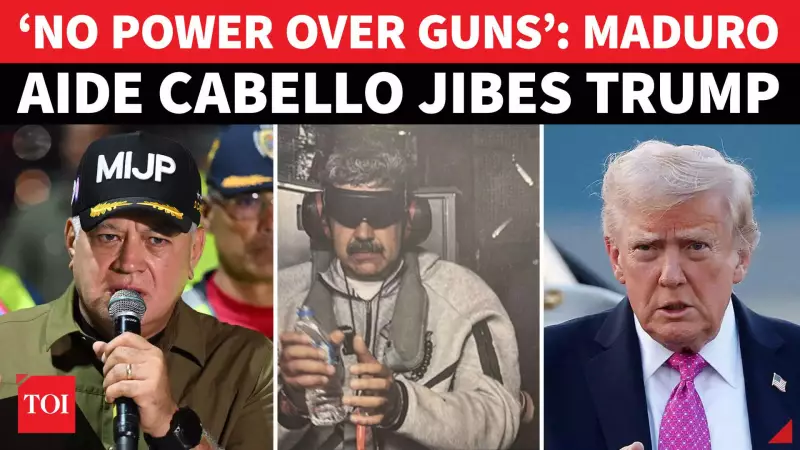
In a defiant address, a top aide to Venezuela's former leader has launched a sharp critique against the United States, asserting that calm prevails in the capital despite a dramatic American military intervention.
Cabello's Firm Rebuttal to US Assault
Venezuela's Interior Minister, Diosdado Cabello, stated that order and tranquility continue to reign in Caracas. This statement comes even after the significant U.S. military attack on January 3, 2026, which led to the capture of the country's former president, Nicolás Maduro. Cabello emphasised that the Venezuelan state retains complete authority and an absolute monopoly on the use of weaponry.
He positioned this state control over arms as a critical safeguard. According to the minister, this monopoly is what prevents the outbreak of large-scale, chaotic violence that has been witnessed in other nations facing similar turmoil. Cabello's remarks directly challenge the narrative of internal collapse following the US operation.

US Action Labelled as Sole Source of Violence
In his statements, the Venezuelan minister placed the blame for recent disturbances squarely on the United States. He denounced the American assault as the single source of violence in the period, arguing that Venezuela was on a steady path back to normalcy. The peace and security of the nation were disrupted solely by the events of January 3, he claimed.
Cabello insisted that the situation is gradually returning to normal, minimising any suggestion of ongoing internal strife or popular uprising against the state apparatus. His comments aim to project an image of resilience and unbroken governmental control.
Weapons Monopoly Defended Amid Geopolitical Crisis
Amidst the ongoing geopolitical tensions, the minister strongly defended the government's exclusive right to bear arms. He cited this centralized control as a primary reason for the relative stability within Venezuela's borders, especially when compared to other regions experiencing conflict.
This defence of the state's weapons monopoly is a key part of the government's argument for its legitimacy and capability to maintain order. It serves as a counterpoint to accusations of fragility and is presented as a bulwark against external interference and internal discord.
The developments mark a significant escalation in the long-standing tensions between Venezuela and the United States, with the Latin American nation's leadership refusing to show signs of capitulation after the capture of its former head of state.