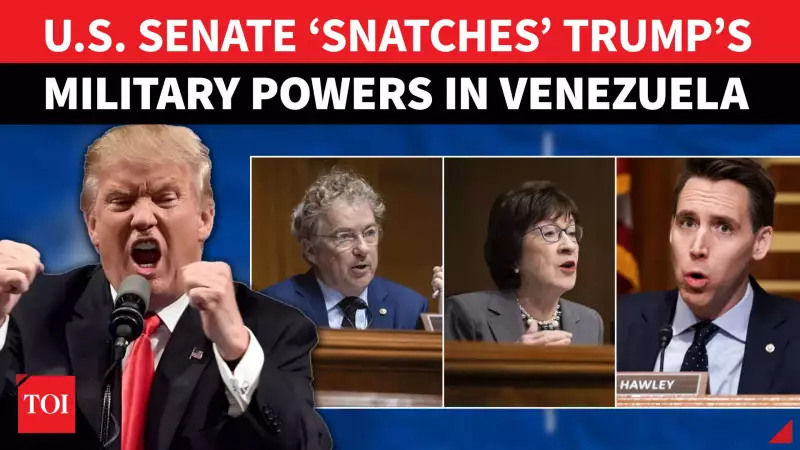
In a dramatic political earthquake, the United States Senate has delivered a stunning rebuke to President Donald Trump, voting to restrict his authority to launch further military action in Venezuela. The move came after a controversial raid that resulted in the capture of Venezuelan leader Nicolás Maduro.
A Rare Bipartisan Stand Against Presidential Power
The Senate advanced a significant war powers resolution on January 9, 2026, in a move that caught the White House by surprise. The final vote was 52 to 47, a margin made possible by a crucial rebellion within the President's own party. Five Republican senators broke ranks to join Democrats, creating a rare bipartisan coalition aimed at reining in executive military authority.
This resolution directly challenges the President's ability to initiate new military engagements in Venezuela without seeking explicit approval from Congress first. The action was triggered by the fallout from the dramatic military operation that led to Maduro's capture, an event that has intensified debates over the scope of presidential war powers.

Trump's Fury and the Constitutional Clash
President Trump reacted with immediate fury, erupting in anger and branding the Senate's measure a direct threat to US national security. He argued that it ties the hands of the commander-in-chief during a volatile geopolitical situation. However, the Senate's action is being hailed by many as a vital reassertion of Congress's constitutional role in declaring war, a power that has been seen as eroding over decades.
The resolution sends a powerful warning against the use of unchecked executive force, marking a historic moment in the ongoing tension between the White House and Capitol Hill over who controls the nation's war-making decisions. While the measure is currently seen as largely symbolic—as it faces an almost certain veto from President Trump—its passage alone represents a sharp political and institutional critique.
Implications and the Road Ahead
The shockwaves from this vote are resonating throughout Washington, DC, highlighting deep concerns even among some Republicans about military escalation. The bipartisan nature of the vote underscores the seriousness of the concerns regarding the Venezuela intervention.
This development occurs alongside other related revelations, including a US military admission that seven elite Delta Force soldiers were injured during the raid to capture Maduro. Furthermore, international reactions have been sharp, with leaders like Turkey's Recep Tayyip Erdogan condemning the US action in Venezuela as illegal.
The Senate's decisive move sets the stage for a major confrontation between the legislative and executive branches. It poses critical questions about the future of American foreign policy and the balance of power within the US government, especially concerning military interventions abroad.