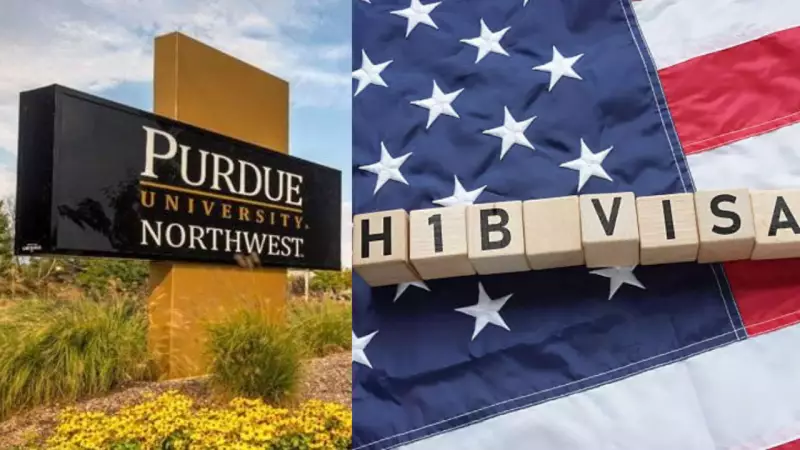
A Republican lawmaker from Indiana has launched a sharp critique against Purdue University Northwest for its decision to seek an H-1B visa to appoint a foreign national as an assistant professor of marketing, igniting a fresh debate on the use of foreign work visas in American higher education.
The Controversial Hiring Decision
State Representative Andrew Ireland publicly challenged the university's move to hire a foreign professor for a role starting June 1, 2026, at an annual salary of $127,500. The position, based at the Hammond campus, is slated to run until May 31, 2029. In a post on social media platform X, Ireland expressed his dismay, framing it as an issue of fairness to domestic talent.
"Taxpayer-funded Purdue University disclosed it is hiring a foreigner on an H-1B visa to teach marketing," Ireland stated. He questioned the necessity of the visa, pointing to the vast local talent pool. "Does anyone seriously believe no American in the Chicago area can teach marketing for $127,500 a year?" he asked, further noting that the same university runs a PhD program in marketing, implying a ready supply of qualified candidates.

Purdue's Reliance on the H-1B Program
This incident is not an isolated case for the Purdue University system. Data from the United States Citizenship and Immigration Services (USCIS) reveals that Purdue filed a significant 265 H-1B Labor Condition Applications in fiscal year 2025, with 258 receiving approval. Nationally, USCIS approved 399,395 H-1B petitions in fiscal year 2024, marking a 3% annual increase, with educational institutions accounting for 5.6% of these approvals.
The H-1B visa program is designed for "specialty occupations" where employers cannot find qualified American workers. However, critics, particularly within the 'America First' and MAGA movements, argue that in fields like marketing, software engineering, and data science, there is ample domestic talent. They contend that such visas suppress wages and displace American graduates, limiting their opportunities even at prestigious institutions.
A Clash of Perspectives on Talent and Nationality
The debate spilled into the comments section of Ireland's post, where a social media user defended the university's potential choice, stating, "Universities try to hire the best person for the job, regardless of whether he is American or foreign." The user invoked the example of Albert Einstein, suggesting that under Ireland's logic, Princeton would not have hired the famed physicist.
Ireland countered this argument by emphasizing the scale of the local population. "7.5 million people live within an hour of campus," he replied. "Do you really think none are better hires as an assistant marketing professor at a satellite campus?" He suggested that if a candidate possessed extraordinary, world-class talent akin to Einstein's, the university should utilize the O-1 visa for individuals with extraordinary ability, rather than the H-1B.
This controversy highlights the ongoing tension in U.S. immigration and employment policy. While figures like former President Donald Trump and entrepreneurs such as Elon Musk and Vivek Ramaswamy have defended the H-1B program as a vital tool to attract global talent, nationalist voices within the GOP see it as a threat to American workers. The case of Purdue Northwest's marketing professorship has become a microcosm of this much larger, national debate.