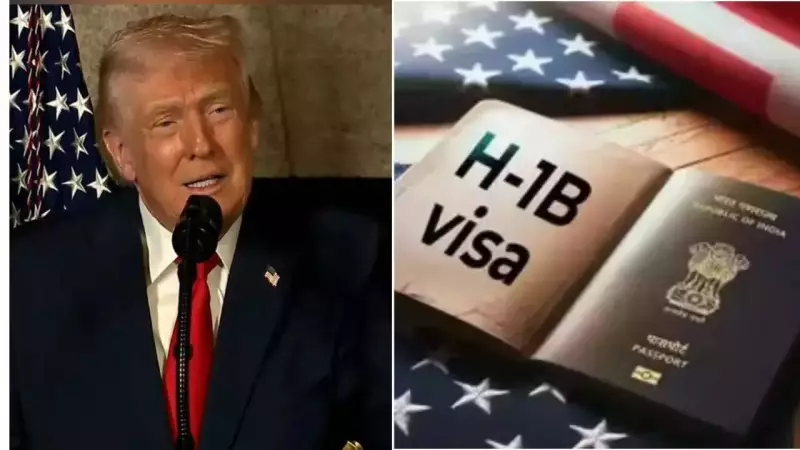
In a significant ruling impacting the American technology sector and global talent mobility, a US federal judge has upheld a controversial Trump-era proposal to impose a hefty $100,000 fee on new H-1B visa applications. This decision represents a major setback for US tech giants and business associations who had legally challenged the move, arguing it would cripple their ability to hire specialised foreign talent.
Court Rejects Business Challenge
The ruling was delivered by US District Judge Beryl Howell in Washington, DC on Tuesday. She dismissed a lawsuit filed by the US Chamber of Commerce, which contended that the steep fee increase violated federal immigration law. The business group had warned that the cost would force companies, hospitals, and other employers to slash jobs and critical services.
Judge Howell, however, determined that former President Donald Trump possessed the legal authority to mandate the fee. She noted his proclamation was issued under an explicit statutory grant of presidential power. "The parties’ vigorous debate over the ultimate wisdom of this political judgment is not within the province of the courts," Howell wrote in her decision, as reported by Reuters. She added, "So long as the actions dictated by the policy decision and articulated in the Proclamation fit within the confines of the law, the Proclamation must be upheld."

The Chamber of Commerce had strongly argued that the president lacked the power to unilaterally impose such a fee. Daryl Joseffer, the Chamber's executive vice president and chief counsel, stated that the burden would fall heavily on small and medium-sized businesses. "We are disappointed in the court’s decision and are considering further legal options to ensure that the H-1B visa program can operate as Congress intended," Joseffer said in an official statement.
What the $100,000 H-1B Fee Entails
The H-1B visa program is a critical pipeline for US companies, especially in the technology sector, to hire foreign professionals in specialised occupations. The program is capped at 65,000 visas annually, with an extra 20,000 reserved for holders of advanced degrees. These visas are typically valid for a period of three to six years.
Historically, the total government and processing fees for an H-1B visa have ranged between approximately $2,000 and $5,000, depending on company size and other factors. The Trump administration's order seeks to escalate this cost to a staggering $100,000 for new applications, marking an unprecedented increase.
The Chamber and other critics maintain that this exorbitant fee would place businesses in a difficult position: either absorb drastically higher labour costs or significantly reduce hiring of highly skilled foreign workers. Apart from the Chamber's lawsuit, separate legal challenges have been mounted by a coalition of Democratic-led US states and a group of employers, non-profits, and religious organizations.
Rationale and Wider Implications
In his original order, former President Trump cited his authority under federal immigration law to restrict the entry of foreign nationals if deemed detrimental to US interests. Judge Howell supported the administration's stance, noting it had sufficiently backed its claim that the H-1B program was displacing American workers. The ruling pointed to instances where companies laid off thousands of US employees while concurrently petitioning for H-1B visas.
This ruling has direct and profound implications for India, as a vast majority of H-1B visa recipients are Indian nationals working in STEM fields. For Indian IT professionals and the US companies that rely on them, this upheld fee proposal introduces significant financial uncertainty and could alter hiring strategies for critical tech roles across Silicon Valley and beyond.