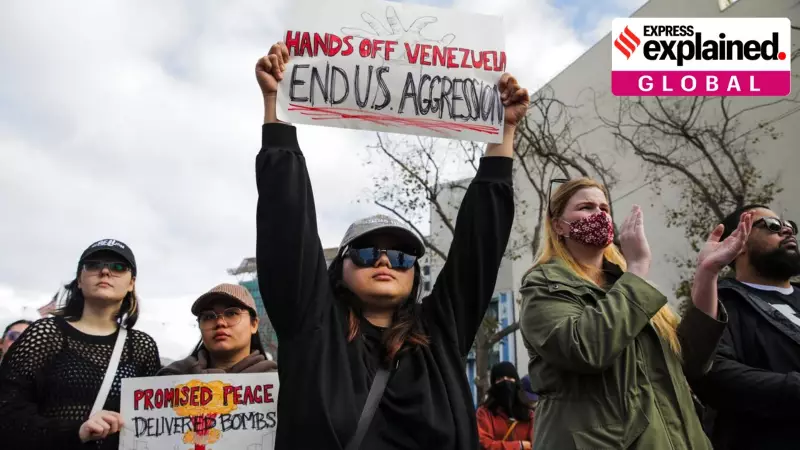
In a dramatic escalation of military interventionism, United States elite Delta Forces captured Venezuelan President Nicolás Maduro on Saturday, January 3, 2026. The audacious operation, ordered by President Donald Trump, has plunged the South American nation into profound uncertainty and marks a stark reversal of Trump's earlier promises to avoid foreign wars.
The 'Don-roe Doctrine' and a Return to Interventionism
Justifying the action, President Trump invoked a foreign policy principle over two centuries old: the Monroe Doctrine of 1823. This doctrine, originally intended to ward off European colonial influence in the Americas, has been rebranded by Trump as the "Don-roe Doctrine." For decades, successive US administrations had distanced themselves from this overtly interventionist stance. Trump's move, prefigured in last month's security strategy, represents a worrying reassertion of America's claim to hegemony in its hemisphere.
This aligns with a pattern of increased military action under Trump over the past year. The administration has recently ordered airstrikes in Syria and Nigeria, threatened Iran, and previously targeted facilities in Iran, Yemen, Somalia, and Iraq in 2025. The capture of a sitting head of state, however, represents a significant escalation.

Oil: The Central Motive Behind the Venezuela Move
Analysts point to one overwhelming reason for targeting Venezuela: crude oil. Venezuela sits atop the world's largest proven oil reserves, estimated by the US Energy Information Administration (EIA) at over 300 billion barrels—roughly one-fifth of the global total. Despite this wealth, its current production is a meager 1 million barrels per day, less than 1% of world output, due to chronic mismanagement and crumbling infrastructure.
Trump made the economic motive explicit. At a news conference from his Mar-a-Lago residence on Saturday, he stated the US would take control of Venezuela's reserves and field American companies to invest "billions of dollars" to refurbish the oil industry. "We're going to have our very large United States oil companies... go in, spend billions of dollars, fix the badly broken infrastructure," Trump declared.
This focus on oil has led to widespread accusations of economic predation. "Venezuela has the largest oil reserves in the world. Any politician, journalist or commentator who leaves this crucial fact out... is willingly distorting the truth. Just call it what it is. Straight up theft," said Youssef Kobo of the advocacy group ASATT-EU.
Political Chaos and Domestic Backlash
The aftermath of the capture is chaotic. While Trump suggested Venezuelan Vice President Delcy Rodriguez had agreed to help the US run the country, Rodriguez later gave a national address to denounce the US attack. The future remains unclear: will the US become an occupying force, or install a friendly leader in Caracas?
Domestically, the action has triggered significant backlash from Trump's own political base, which was promised an end to "never-ending wars." Congresswoman Marjorie Taylor Greene, a former Trump loyalist, condemned the move on X, stating, "This is what many in Maga thought they voted to end. Boy were we wrong." Republican Congressman Thomas Massie highlighted the contradiction between the legal justification for Maduro's arrest (weapons and cocaine trafficking) and Trump's stated goal of reclaiming US oil assets.
The operation also raises questions about Venezuela's contested political landscape. The July 2024 presidential election, where opposition candidate Edmundo Gonzalez was widely believed to have defeated Maduro, remains unresolved. The role of opposition figures like the exiled Nobel laureate María Corina Machado is also uncertain, especially after Trump dismissed her leadership potential.
The coming weeks will determine whether this intervention stabilizes Venezuela or leads to a protracted conflict, all under the shadow of the revived and rebranded Monroe Doctrine—a doctrine now firmly tied to the pursuit of energy resources.