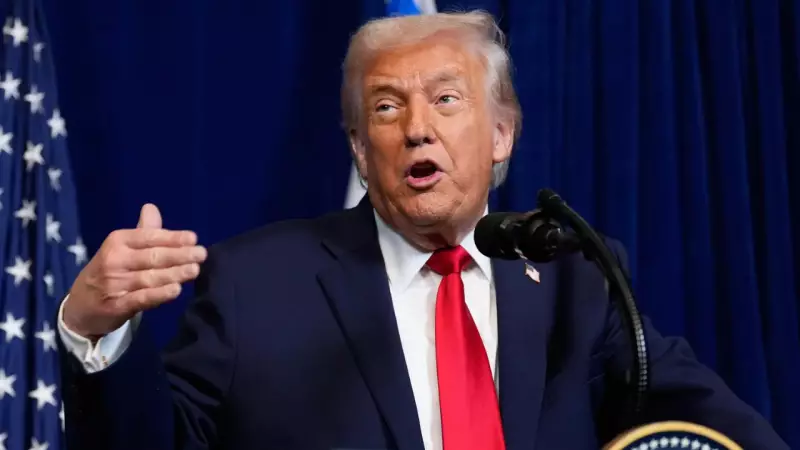
In a dramatic turn of events, US President Donald Trump has declared a recent military operation in Venezuela a resounding success, culminating in the capture of the country's President, Nicolás Maduro. Trump opened a press conference by hailing the overnight raid as a historic display of American military prowess.
A Daring Nighttime Assault
The 47th President of the United States described the mission as “one of the most stunning attacks and effective and powerful displays of American military might and competence in American history.” The operation, which took place in the early hours of Saturday, followed weeks of escalating pressure from the Trump administration on the Venezuelan government.
Providing vivid details in an interview on “Fox and Friends Weekend”, Trump revealed that Maduro was “highly guarded” inside a presidential palace “like a fortress.” US forces, he claimed, were fully prepared for the challenge, having rehearsed on a full-scale replica of the building and equipped with “massive blowtorches” to breach steel-reinforced rooms. “He didn’t get that space closed,” Trump stated. “We were prepared.”

The assault was executed under the cover of darkness, with Trump asserting that the US turned off “almost all of the lights in Caracas.” Residents reported hearing at least seven explosions during the raid, which lasted less than 30 minutes. While Venezuela’s Vice President, Delcy Rodríguez, confirmed that civilians and military personnel were killed, she did not provide specific figures. President Trump claimed only “a couple of guys were hit” on the American side.
Trump Outlines Post-Operation Plans
Following the capture, President Trump made a significant announcement regarding the future of the South American nation. He declared that the United States is going to run Venezuela until a proper transition can be established. Emphasising the unique capability of the US, he argued that “No nation in the world could achieve what America achieved yesterday,” adding that Venezuelan military capabilities had been completely neutralised.
Speaking on Fox News, Trump confirmed the US would play a central role in shaping Venezuela's path forward. “We'll be involved in it very much,” he said, cautioning, “We can’t take a chance in letting somebody else run and just take over what he left.” The White House cited adverse weather conditions for delaying the operation by several days prior to its execution.
Legal Charges and Global Implications
In a related development, the US Justice Department has released an indictment accusing the captured President Maduro and another official, Flores, of involvement in a narco-terrorism conspiracy. This legal move provides a backdrop to the administration's justification for the high-stakes military intervention.
The unprecedented raid marks a severe escalation in the long-standing political and economic crisis in Venezuela, setting the stage for a complex period of transition under direct US involvement. The global community watches closely as this bold action redefines the rules of engagement in international disputes and foreshadows a new chapter for Venezuelan governance.