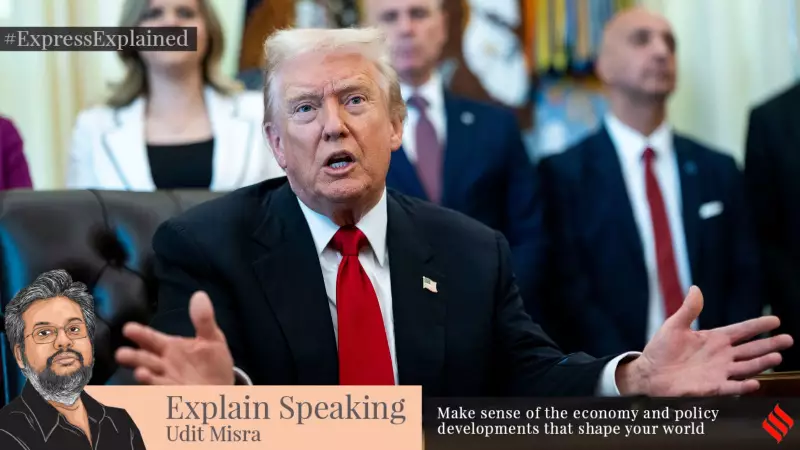
In a remarkable policy reversal, President Donald Trump has significantly scaled back his signature tariff program just one year after implementing sweeping trade barriers that were supposed to revitalize American manufacturing. The dramatic shift comes as economic data reveals the tariffs have triggered exactly the opposite effects Trump promised - higher inflation, rising unemployment, and slowing economic growth.
The Grand Tariff Experiment Unravels
When Trump assumed office for his second term in November 2024, he brought with him two central campaign promises: strict immigration controls and solving the cost-of-living crisis that plagued the Biden administration. His chosen weapon against economic stagnation was aggressive tariffs on imports from virtually all trading partners.
The theory was straightforward - by making foreign goods more expensive through tariffs, companies worldwide would be forced to establish production facilities within the United States. This would create American jobs, stimulate economic growth, and ultimately reduce inflation by boosting domestic manufacturing capacity.

However, by November 2025, the reality has proven starkly different. On November 14, the Trump administration announced tariff reductions on essential agricultural commodities including bananas, coffee, and beef - staples in American households. Simultaneously, the government floated the idea of distributing a $2,000 dividend to Americans earning less than $100,000 annually, funded by tariff revenues.
Economic Fallout: Data Doesn't Lie
The economic indicators tell a compelling story of policy failure. Inflation rates, which had been declining since early 2025, reversed course dramatically in April - exactly when Trump announced his comprehensive tariff package. According to Federal Reserve Vice Chair Philip N. Jefferson, inflation has stalled at nearly 3%, with tariffs identified as the primary culprit.
Unemployment tells a similar troubling narrative. The jobless rate has climbed steadily throughout 2025, with Jefferson projecting further increases by year's end from the 4.3% recorded in August. The International Monetary Fund has downgraded US growth projections from 2.8% in 2024 to just 2% for 2025, citing "greater policy uncertainty, higher trade barriers, and lower growth in both the labour force and employment."
Consumer sentiment has collapsed to levels not seen since 1978, with the University of Michigan's November index showing a 30% decline compared to the previous year. The only exception appears among wealthy Americans with significant stock holdings, creating what economists describe as a "K-shaped" economic recovery where the rich prosper while ordinary citizens struggle.
Diplomatic and Currency Consequences
The damage extends beyond domestic economic indicators. US diplomatic relations have suffered significantly, with even traditionally close allies like Canada expressing frustration. Canadian Prime Minister Mark Carney recently declared that the economic relationship between the two nations is effectively over, with previous strengths becoming weaknesses under the new tariff regime.
Perhaps most alarmingly for American global dominance, the US dollar has weakened against all major currencies since the start of 2025. The dollar's strength has long been America's secret weapon in global affairs, but declining trust in US policy stability threatens this fundamental advantage.
Political Reality Forces Retreat
Several political factors have compelled the tariff reversal. November's state elections saw Democrats scoring significant victories in traditional Republican strongholds, with campaigns focused squarely on addressing the affordability crisis. Trump's approval ratings have plummeted from 52% at the start of his term to 42% by mid-November, with some polls placing him as low as 38%.
The specific tariff reductions reveal the political calculus at work. While overall inflation stood at 3% in September, essential food items showed dramatically higher increases: bananas at 7%, beef at 15%, and coffee at 19%. American households were feeling the pinch exactly where it hurts most - at the grocery store.

Adding to the pressure, Trump's tariff policy faces legal challenges in the Supreme Court, which may rule that the president overstepped constitutional boundaries by imposing tariffs without congressional approval. Meanwhile, cracks have appeared within Trump's MAGA base, with public disputes emerging between the president and conservative members of Congress.
The Economic Truth About Tariffs
Economists had warned from the beginning that Trump's tariff approach was fundamentally flawed. Tariffs function as taxes on domestic consumers, raising prices without increasing supply or quality. This either reduces trade volume (hurting American exports as foreigners have fewer dollars to spend) or leaves consumers with less disposable income for domestic purchases.
The US Chamber of Commerce has been particularly vocal, noting that "American families are facing thousands of dollars in higher prices as a result of these increased taxes. Small businesses, manufacturers, and ranchers are struggling with higher costs." Manufacturing data confirms the damage, with the sector contracting for eight consecutive months through October.
The proposed $2,000 dividend program highlights the policy's mathematical implausibility. With tariff revenues totaling $195 billion in fiscal year 2025, the proposed $450 billion payout would require more than double the collected funds - an obvious fiscal impossibility that underscores the policy's desperation.
Global Implications and Lessons for India
The American tariff experiment offers crucial lessons for countries like India pursuing self-reliance policies. While the intention to boost domestic manufacturing is understandable, the methods matter enormously. Blanket protectionism risks triggering inflation, reducing trade, and damaging diplomatic relationships - exactly the outcomes now evident in the United States.
As Trump recalibrates his approach, the fundamental economic principles remain unchanged: tariffs are consumer taxes, global supply chains are deeply interconnected, and policy credibility matters for currency strength and global influence. The question remains whether this policy reversal comes too late to prevent lasting damage to America's economic standing and whether other nations will learn from this expensive experiment in protectionism.