

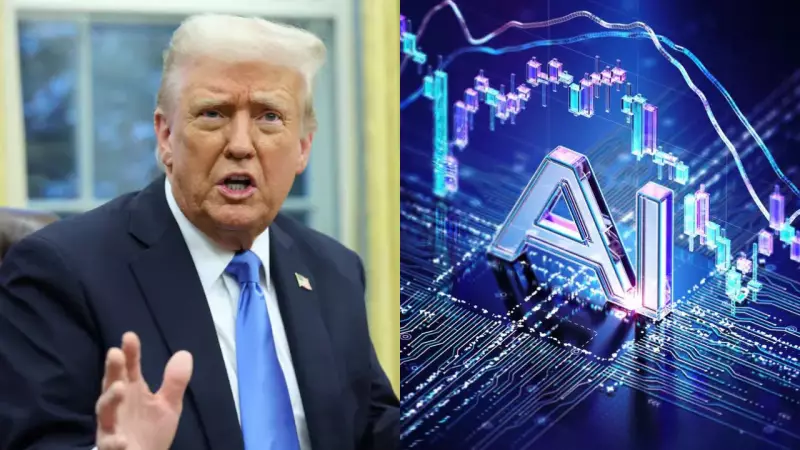
In a significant move that could reshape America's artificial intelligence landscape, President Donald Trump is preparing to sign an executive order that would grant the federal government sweeping powers to regulate AI across the nation. This controversial legislation could potentially trigger legal battles against US states that have established their own AI regulations.
The AI Litigation Task Force: Challenging State Laws
According to a draft order obtained by The Verge, the administration plans to create a specialized "AI Litigation Task Force" that would operate under the Attorney General's authority. This task force would have one primary mission: to challenge State AI laws that the federal government believes could hinder the growth of the AI industry.
The draft document specifically mentions existing state regulations that could face legal challenges, including California's comprehensive rules on AI safety and catastrophic risk assessment. Colorado's legislation addressing algorithmic discrimination also appears on the potential target list. The task force would coordinate with White House Special Advisors, particularly David Sacks, who serves as Trump's Special Advisor for AI and Crypto.

Trump's Anti-Woke AI Agenda
President Trump has been increasingly vocal about his concerns regarding state-level AI regulations. During his recent appearance at the US-Saudi Investment Forum, he reiterated his call for a moratorium on state AI laws, framing it as a necessary measure to combat what he termed "woke" ideology.
"You can't go through 50 states. You have to get one approval. 50 is a disaster," Trump emphasized. "Because you'll have one woke state, and you'll have to do all woke. You'll be back in the woke business. We don't have woke anymore in this country. It's virtually illegal. You'll have a couple of wokesters."
This position aligns with the broader AI Action Plan that the Trump administration released earlier this year. The plan directed multiple federal agencies, including the Federal Communications Commission (FCC), to explore methods for bypassing what they describe as "onerous" state and local rules that might impede AI industry growth and innovation.
90-Day Implementation Timeline and Consequences
The proposed executive order outlines an aggressive 90-day implementation schedule for key federal agencies. The Department of Justice, Federal Trade Commission, Department of Commerce, and FCC would all play crucial roles in executing this directive.
Within the first 90 days after the order is signed, the Secretary of Commerce would be required to publish a comprehensive report identifying states that might be violating Trump's AI policy objectives. More significantly, this report would determine which states could lose eligibility for the Broadband Equity, Access, and Deployment (BEAD) program, which provides crucial funding for rural broadband access.
Simultaneously, the FTC would examine whether states requiring AI companies to modify their algorithms might be breaking laws that prohibit unfair or deceptive practices.
FCC's Potential Role in Overriding State Laws
During Politico's AI & Tech Summit in September, FCC Commissioner Brendan Carr suggested a possible interpretation of the Communications Act that could empower the FCC to override state legislation. "Effectively, if a state or local law is effectively prohibiting the deployment of this 'modern infrastructure,' then the FCC has authority to step in there," Carr explained to Politico's Alex Burns.
Carr specifically referenced a proposed California law that would mandate AI companies to disclose their safety-testing models. He indicated that the FCC's powers could potentially block such legislation, supporting President Trump's objective of preventing what he calls "woke AI" that might carry ideological bias.
The FCC commissioner also expressed concerns about the European Union's Digital Safety Act, warning that "their AI models are not going to be truth-seeking AI models, but they're going to be woke AI models, going to be AI models that are promoting DEI [Diversity, Equity, and Inclusion]."

While the concept of federal agencies overriding state AI laws will likely face legal challenges, the creation of a litigation task force could effectively slow down states' efforts to regulate artificial intelligence within their jurisdictions. This development represents a significant escalation in the ongoing tension between federal and state authority in technology governance.





