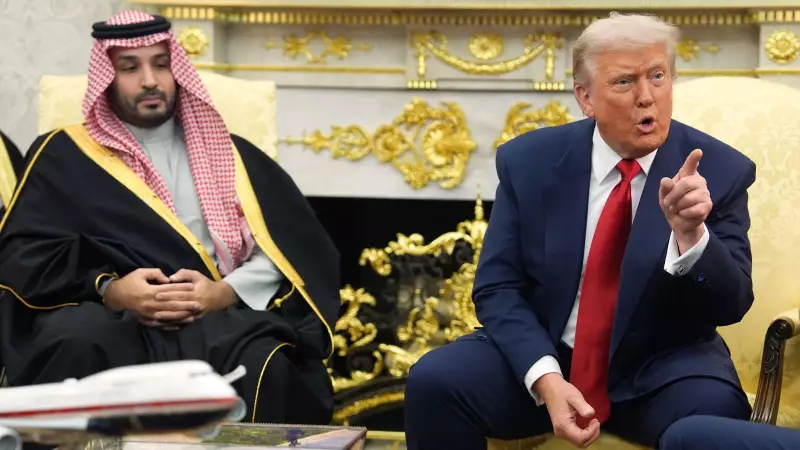
US President Donald Trump’s lavish reception for Saudi Crown Prince Mohammed bin Salman (MbS) at the White House this week was a spectacle of power and pomp. However, the event took a deeply controversial turn when a journalist’s question about a state-sponsored murder was met with presidential fury and a shocking dismissal of a human life.
A Lavish Welcome and a Chilling Exchange
The visit was marked by an extraordinary display of military honour and diplomatic warmth. Flag-bearing horses and a flypast by F-15 and F-35 fighter jets set the stage for the meeting. The centrepiece was the announcement elevating Saudi Arabia to the status of a major non-NATO ally, a move seen as a reward for a potential $1 trillion deal promised by the kingdom.
The predictable script was shattered in the Oval Office. When Mary Bruce of ABC News asked MbS about the 2018 killing of Washington Post columnist Jamal Khashoggi—an act US intelligence has traced back to the prince himself—President Trump bristled. He launched into an attack, chastising Bruce for her "horrible, insubordinate" attitude.

Trump then proceeded to absolve the Saudi leader of any responsibility. In a stunning display of indifference, he labelled Khashoggi "extremely controversial" and infamously shrugged off the brutal murder with the phrase, "things happen."
A Pattern of Callousness Versus a Veneer of Diplomacy
The incident triggered widespread condemnation, highlighting the Trump administration's characteristic blend of bullying and vulgarity. MbS's own vague response, calling the killing a "painful and a huge mistake," was deemed insufficient, yet still more diplomatic than the US President's outright denial of facts and basic human empathy.
While Trump's behaviour seems uniquely outrageous, a look at history reveals that his insensitivity to human rights abroad is not an anomaly among US presidents. What differs is the packaging.
- Dwight Eisenhower's administration orchestrated the 1953 coup in Iran, overthrowing a democratic government to secure oil interests and ultimately paving the way for a repressive theocracy.
- Bill Clinton's stringent sanctions on Iraq resulted in severe food shortages and a devastating humanitarian crisis for the civilian population.
- George W. Bush's catastrophic "war on terror" in Iraq and Afghanistan led to hundreds of thousands of deaths and regional instability that persists today.
Furthermore, Trump is not the first US president to engage with MbS post-Khashoggi. Joe Biden, who had vowed on the campaign trail to make Saudi Arabia a "pariah" for the murder, famously fist-bumped the crown prince during a 2022 trip to persuade the kingdom to increase oil production.
The Bully at Home and Abroad
The key distinction lies in rhetoric. Past presidents often cloaked destructive interventions in the language of freedom, democracy, and American leadership. Their legacies are often viewed with a softening nostalgia, a privilege denied to Trump, whose outrageousness—from calling a journalist "piggy" to sharing racist memes—sets him apart.
Ultimately, the article argues that the difference between a bully on the international stage and one who also bullies at home is just a thin veneer of statesmanship. The actions beyond American shores have often been similarly callous, regardless of the diplomatic language used to justify them.