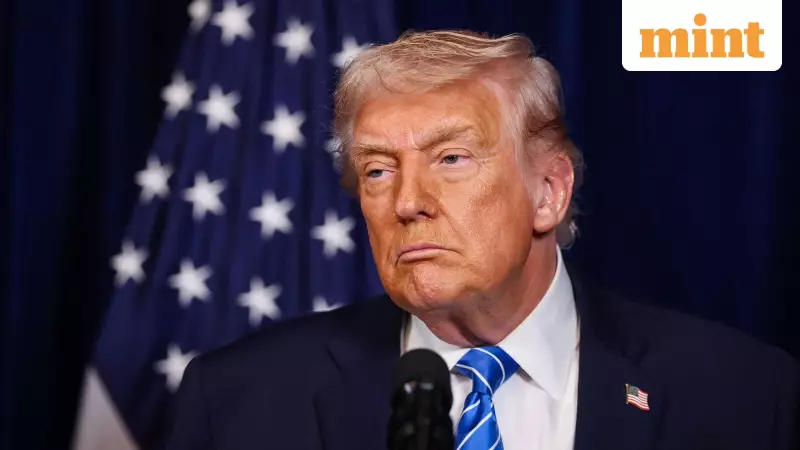
In a significant policy reversal, former US President Donald Trump has officially discontinued the long-standing Corporate Average Fuel Economy (CAFE) mandates. These rules, first enacted in 1975, were officially labelled a "green new scam" by Trump in late 2025.
The Core Contradictions of CAFE Rules
Trump argued that the mandates forced Americans to pay excessive prices for underperforming vehicles. However, a deeper analysis reveals more complex market distortions. While consumers willingly paid market prices for electric vehicles (EVs), which generally performed well, the production cost often exceeded the sale price by tens of thousands of dollars.
This economic gap led manufacturers to focus on large, luxury EVs to minimise losses. Ironically, the lifecycle emissions of these heavy, powerful electric cars often surpassed those of the conventional vehicles they were meant to replace, undermining the environmental goal.

As noted decades ago by Robert Crandall of the Brookings Institution, CAFE was never the right solution, regardless of how the problem was defined—be it saving gasoline, reducing pollution, or preserving small car manufacturing in US factories.
A History of Policy Nonsense and Market Distortion
The article traces a history of flawed policy logic. It references a landmark 2007 speech by then-Senator Barack Obama in Detroit. Obama suggested the Big Three automakers were failing because they profitably built cars consumers wanted, instead of complying with fuel-economy rules that required them to produce money-losing models.
This "nonsense," as the author calls it, persisted. Recently, media outlets like the New York Times lamented that Trump's action halted a Biden-era program promising to cut both gasoline prices and emissions simultaneously—a clear contradiction, as lower fuel prices typically encourage higher consumption and emissions.
The failure of such logic is evident in the outcomes of President Joe Biden's Inflation Reduction Act. Subsidies for green energy, instead of reducing emissions, were associated with an overall increase in energy consumption, exactly as basic economics would predict.
Fuel Economy vs. Efficiency: The Fatal Flaw
The author identifies a fundamental flaw in the policy's very premise. CAFE focused on "fuel economy"—gasoline used by a specific vehicle to travel from point A to B. A sounder concept is "fuel efficiency."
Technological progress is undeniable. A modern Honda Civic achieves better mileage than its 1985 counterpart, despite being 37% heavier (due largely to safety features) and having double the horsepower.
The lesson is that efficiency gains are driven by technology and market demand. If the goal is to use these gains to reduce total fuel consumption, rather than enable bigger cars, the direct solution is a gasoline tax. The author argues that the inability to win the political argument for a tax is no justification for a "second best" policy like CAFE, which distorted consumer choice toward lighter, less safe vehicles—a shift estimated to cause over 3,000 additional road deaths annually.
The article concludes by connecting decades of policy failure to a broader media and institutional breakdown. It cites former Time columnist Joe Klein, who notes that the press and political class often deem a government program a success upon its passage, rarely questioning its subsequent management or real-world efficacy.
The final, pointed observation is that when this question remains unasked for too long, democracy's answer can be a figure like Donald Trump—whose accidental rise was partly fueled by the very institutional failures he now challenges by ending a 50-year-old policy with largely perverse consequences.