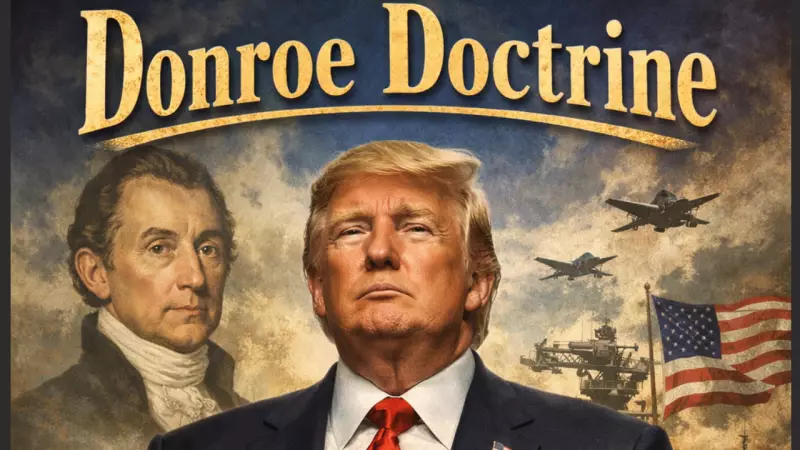
In a dramatic shift for US foreign policy, President Donald Trump has resurrected and rebranded a nearly 200-year-old doctrine, turning it into a personal blueprint for asserting American dominance across the Western Hemisphere. What began as the Monroe Doctrine in 1823, a warning to European empires, is now being championed by Trump as the 'Donroe Doctrine'—a louder, brasher, and unmistakably Trumpian vision for the 21st century.
From Historical Relic to Modern Mandate
For decades, the Monroe Doctrine was viewed as a relic of a bygone era. Former US Secretary of State John Kerry even declared it "over." However, President Trump has forcefully dragged it back into the spotlight, framing its revival as essential for peace and American interests. "It's about PEACE on Earth. We gotta have peace. It's our hemisphere," Trump stated, criticising past presidents for losing sight of the doctrine's original intent.
This isn't merely a rhetorical revival. Trump has operationalised this philosophy, pushing it beyond its original defensive purpose. While President James Monroe aimed to keep foreign powers out of the Americas, Trump's approach, dubbed the 'Trump Corollary,' emphasises assertive American dominance within the hemisphere itself.

The Doctrine in Action: Venezuela as the First Test Case
The most striking application of this renewed doctrine was the dramatic military operation against Venezuela. In early 2026, under Operation Absolute Resolve, the US launched rapid strikes on Caracas, culminating in the capture of Venezuelan leader Nicolás Maduro and his wife, Cilia Flores.
The operation, reportedly over in less than 30 minutes, followed months of escalating tensions. The US had long accused Maduro of drug trafficking and corruption. The mission involved a formidable naval armada, including the USS Gerald R Ford carrier strike group. Maduro was subsequently transferred to the US military prison at Guantanamo Bay and now faces 'narcoterrorism' charges in New York.
Trump hailed the mission as a historic display of American power. Beyond the immediate military action, his focus was clear: Venezuela's vast oil reserves, the largest in the world at 303 billion barrels. Trump openly stated that US oil companies would move in to "fix the badly broken infrastructure," signalling a sweeping role in Venezuela's energy future.
Expanding the Horizon: Threats to Colombia, Greenland, and Beyond
Fresh from the Venezuela operation, Trump widened his scope, issuing stark warnings to other nations in the region.
Colombia was directly threatened over the cocaine trade. Aboard Air Force One, Trump called the country "very sick" and run by a "sick man," adding that a US operation there "sounds good to me."
Greenland re-emerged as a target for acquisition, with Trump framing control of the Danish territory as an "absolute necessity" for US national security, citing Russian and Chinese activity in the Arctic.
Even traditional allies were not spared. Trump has repeatedly floated the idea of absorbing Canada as the "51st state," mused about renaming the Gulf of Mexico the 'Gulf of America,' and threatened to seize control of the Panama Canal. Regarding Cuba, Secretary of State Marco Rubio warned the communist regime was "in a lot of trouble."
A New Blueprint for Hemispheric Dominance
The implications of the Donroe Doctrine are profound. Trump's actions and rhetoric represent a fundamental shift from deterrence to active assertion of power. By wrapping 19th-century justifications in 21st-century bravado, he has jolted allies, alarmed adversaries, and injected a volatile new dynamic into regional politics.
The doctrine's revival raises critical questions about sovereignty, international law, and the future of US relations across the Americas. With thinly veiled threats and a posture of unshakeable confidence, Trump's message is clear: American dominance in the Western Hemisphere will never be questioned again. The world is now watching to see where this expansionist vision turns next.