Trump's Explosive Confrontations with Journalists Escalate
Tensions between former President Donald Trump and the Washington press corps reached boiling point this week with two dramatic confrontations that saw the Republican leader deploy crude insults against female journalists and threaten to revoke a major network's broadcasting license.
The escalating conflict underscores the deteriorating relationship between the Trump White House and mainstream media, particularly when female reporters ask challenging questions about sensitive topics including the Epstein files and Saudi business dealings.
Air Force One Insult: 'Quiet, Piggy!'
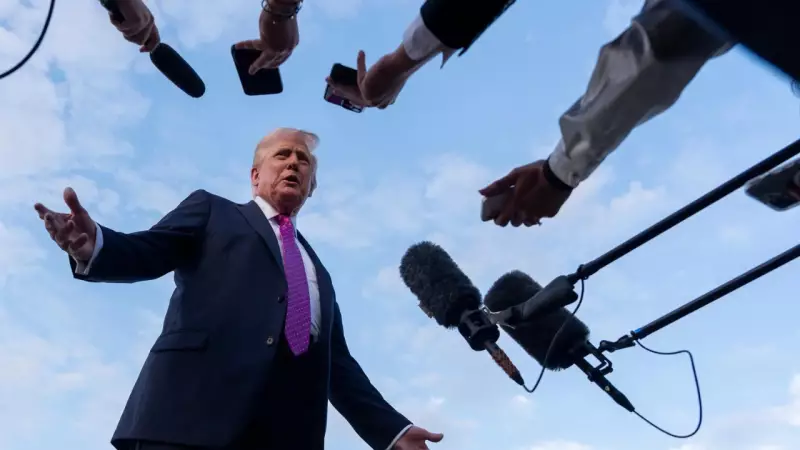
The first incident occurred on November 14 aboard Air Force One when Bloomberg reporter Catherine Lucey, traveling with the President, pressed him about the release of the Epstein files. A visibly irritated Trump raised his index finger and snapped: "Quiet! Quiet, piggy!" - a derogatory remark that immediately spread across media organizations worldwide.

This gendered slur against a female journalist conducting her professional duties marked another chapter in Trump's long history of using personal insults to counter substantive questions from reporters.
White House Showdown: License Threat Against ABC
The conflict intensified on Tuesday at the White House when ABC reporter Mary Bruce confronted Trump about the appropriateness of his family conducting business in Saudi Arabia while he serves as President. She then directed a question to Crown Prince Mohammed bin Salman regarding the U.S. intelligence conclusion that he orchestrated the murder of journalist Jamal Khashoggi.
An enraged Trump told Bruce not to "embarrass our guest by asking a question like that" before erupting at her network ABC, labeling it "fake news" and "one of the worst in the business." When the unflustered reporter followed up by asking why Trump should wait for Congress to release the Epstein files when he could do it himself, the President completely lost his cool.
Trump complained about Bruce's "attitude" and called her a "terrible reporter." He then suggested that ABC's broadcasting license should be revoked because "your news is so fake," going so far as to indicate he would ask the FCC chair to investigate the matter.
Pattern of Gendered Insults Against Female Critics
These latest confrontations fit squarely within Trump's well-documented strategy of using epithets and bullying tactics to control media interactions, particularly when women challenge his narratives. Since entering national politics, he has systematically deployed gendered slurs to undermine female critics:
- Called Hillary Clinton "Nasty Woman" during a 2016 debate
- Referred to Senator Elizabeth Warren as "Pocohontas"
- Labeled Kamala Harris as "cackling Kamala"
Other journalists including Megyn Kelly, Mika Brzezinski, and April Ryan have all faced highly personal, often appearance-based or vaguely sexualized insults from the President. This demonstrates a consistent tactical approach: when confronted by women asking inconvenient questions, pivot immediately to personal humiliation to deflect from the subject matter.
Media Landscape Transformation Under Trump
The White House Correspondents' Association has affirmed the necessity of asking tough questions and condemned the use of "demeaning and unprofessional language." However, most White House reporters continue to tolerate the slights to maintain access in an increasingly challenging professional environment.
Meanwhile, the Trump administration has attempted to counter the liberal mainstream media's tough posture by reshaping the press corps. The White House has drafted several MAGA influencers whose softball questions and sycophantic approach would be "the envy of the North Korean leader," according to observers.

While Trump has manufactured hundreds of disparaging nicknames for male opponents too - including "Lyin' Ted Cruz," "Liddle' Marco Rubio," "Pencil Neck Adam Schiff," and "Crooked Joe Biden" - critics have struggled to make their own nicknames for him stick. Recent attempts like "Cheeto," "Felonious Trump," and "Dozing Donald" (after he was seen napping during a White House event) have failed to gain traction against the "Teflon Don."
The ongoing confrontations highlight the continuing erosion of traditional presidential-media relations and raise serious questions about press freedom and the treatment of female journalists in the political arena.