

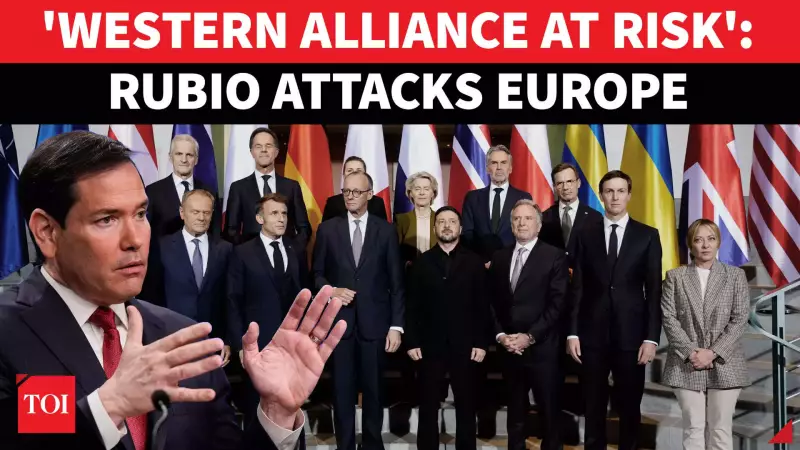
In a robust defence of the Trump administration's foreign policy, US Secretary of State Marco Rubio has forcefully articulated the rationale behind President Donald Trump's new national security strategy. The high-level press conference, held on December 20, 2025, saw Rubio push back against European criticism while issuing a stark warning about the challenges facing the Western alliance.
A Stark Warning on Europe's Future
Rubio presented a sobering analysis of the current state of Europe, arguing the continent is grappling with a process of "civilisational erosion." He identified three primary drivers of this decline: unchecked mass migration, intense economic pressure from China, and a perceived weakening of commitment to the foundational principles that have historically united the West.
The Secretary of State emphasised that sovereign nations possess an undeniable right to control their borders. He described large-scale migration as "highly disruptive" to the social fabric and cohesion of Western societies. Rubio's comments directly challenged the more open immigration policies favoured by several European Union member states.

The Bedrock of the Alliance: Values, Not Just Weapons
A central theme of Rubio's address was the nature of the transatlantic partnership. He argued that without a common foundation built on shared history, culture, and democratic values, organisations like NATO risk being reduced to mere transactional defence agreements. "It is our shared civilisation—not just military cooperation—that is the true bedrock of NATO and Western unity," Rubio stated, insisting this deeper bond must be actively preserved.
This perspective forms the core of the Trump administration's strategic outlook, suggesting that alliances require more than mutual security interests to remain strong in the long term.
Addressing Global Adversaries: Iran and China
Rubio also turned his attention to international adversaries, beginning with Iran. He drew a sharp distinction between the Iranian people and their leadership, accusing the regime of misusing national wealth to fund terrorist activities abroad instead of supporting its own citizens.
On China, the Secretary issued a specific economic warning to Europe. He cautioned that the flood of cheap Chinese goods into European markets is systematically undermining the continent's industrial base. Rubio framed this not merely as an economic issue but as a direct threat to national security, as over-reliance on Chinese manufacturing can create strategic vulnerabilities.
The marathon press conference underscores the Trump administration's continued focus on a national security strategy that prioritises sovereignty, border control, and a reassessment of economic and diplomatic relationships. Rubio's forceful rhetoric signals a clear intent to challenge traditional allies in Europe to align more closely with Washington's worldview or face a potential fraying of the historic transatlantic bond.






