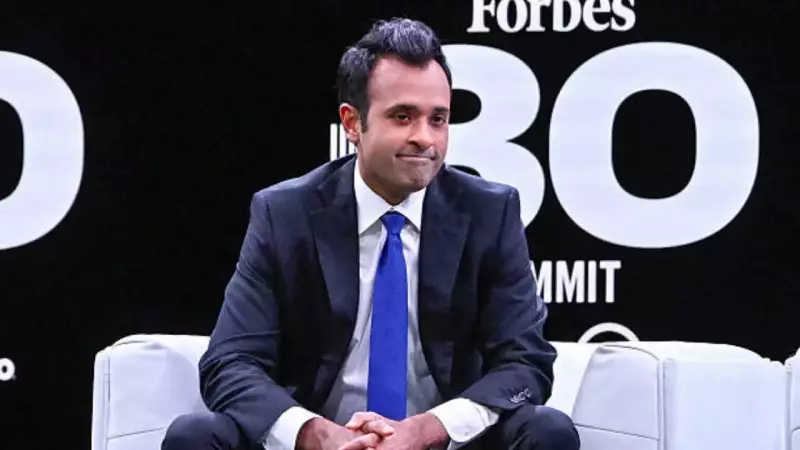
In a move highlighting growing disillusionment with online platforms, Vivek Ramaswamy, the former Republican presidential candidate and current Ohio gubernatorial hopeful, has announced his departure from personal social media accounts. The decision, shared in a Wall Street Journal op-ed on Monday, cites a platform environment he describes as "increasingly disconnected from the electorate" and filled with "negative and bombastic" messages.
Old Excerpt, New Firestorm: The Caste Narrative
Coinciding with his exit, a passage from Ramaswamy's 2021 book, 'Woke, Inc.: Inside Corporate America's Social Justice Scam', began circulating widely on X (formerly Twitter). A post, which garnered over 94.3 thousand views, shared a selectively underlined photo of an excerpt describing the Indian caste system and the author's personal experience with it.
The post framed the text as a boast, highlighting that Ramaswamy was born a Brahmin (the priestly caste), that family servants used different doors, and that he wore the sacred "Poonal" thread. This presentation ignited fierce criticism, with users labeling him a "proud casteist" and his views as discriminatory.

Context Lost: What The Book Actually Says
The viral post, however, presented a fragmented view. In the original text, Ramaswamy uses the caste system as an illustrative example to discuss broader themes of hierarchy and identity politics in American corporations, not as the book's central subject.
He explains that the traditional varna system described a social and occupational hierarchy where status did not always correlate with wealth or power. He notes that Brahmins like his grandfather were obligated to pursue knowledge, often without material gain. The anecdote about domestic help describes them being treated "like relatives," with the caste distinction being a social norm he was unaware of as a child, rather than a reflection of personal prejudice or current belief.
The controversy exemplifies a common social media cycle: selective emphasis, rising outrage, and a hardened narrative, often stripped of the original context intended for a non-Indian audience.
America's Tangled Caste Debate
This incident taps into a growing, and often politicized, discussion around caste in the United States. In 2023, California's legislature passed Senate Bill 403 (SB403) to explicitly ban caste discrimination, though it was later vetoed by Governor Gavin Newsom. Earlier that year, Seattle became the first U.S. city to outlaw such discrimination, followed by Fresno.
Activists point to surveys like a 2018 report from Equality Labs, which found that 25% of Dalit respondents faced caste-based assault and 67% experienced unfair workplace treatment. However, this survey was web-based and self-reported among those already engaged in anti-caste advocacy.
Contrastingly, a Carnegie Endowment and YouGov report found that among Hindu Indian Americans who identify with a caste, only 1% are Dalit, while 80% are upper caste. It also noted that 50% of Hindu Indian Americans have almost no friends from their own caste, suggesting caste is not a primary mode of social segregation in the diaspora for many.
For Ramaswamy, the resurfacing of an old excerpt without its full context likely reinforces his stated reasons for leaving social media—platforms where, as he argues, nuance vanishes and narratives are manufactured to feed cultural conflicts.