Pakistan's Enduring Crisis Cycle: From Partition Trauma to Modern Instability
For Pakistan, crises have ceased to be surprising events. Whether it's a bombing, political upheaval, economic scare, or diplomatic rupture, each incident appears sudden yet feels uncomfortably routine to many Pakistanis. In recent weeks, the nation has once again found itself gripped by familiar scenes: a bruising cricket defeat to India followed days later by a suicide blast in the capital. This sense of repetition extends beyond sport and security, reflecting a deeper pattern that has shaped the country since its traumatic birth during the 1947 Partition.
Founding Trauma and Identity Insecurity
Pakistan's birth was profoundly traumatic. The violence and mass migrations of Partition shattered families and communities, while the first Kashmir war erupted before state institutions were firmly established. Muhammad Ali Jinnah's premature death in 1948 deprived the nation of its strongest unifying leader, leaving fragile institutions and an identity defined largely in opposition to India.
According to analysis in SouthAsianVoices, Pakistan's sense of self has been cast more in counterposition to India than through an affirmative vision. This "excessive focus" on "who we are not" has defined politics from the beginning, viewing Pakistan's survival through an India-centric lens. The "ghost" of 1947 represents this embedded insecurity, with Pakistan beginning as a creation beset by doubt that has persisted through generations.

This persistent identity insecurity helps explain why national crises are seldom questioned for domestic causes. Instead, instability is frequently blamed on foreign conspiracies or imposed threats. While India too was devastated by Partition and fought multiple wars, its military never emerged as a political arbiter, and it is now on track to become the world's third largest economy. Bangladesh, after its own traumatic birth in 1971 and periods of military rule, gradually consolidated a civilian-dominated system. This divergence suggests Pakistan's crisis is not simply the inheritance of 1947 but the result of specific institutional bargains and strategic choices.
Military Dominance and the Security State
Pakistan's early history gave the army a level of power that has shaped the country ever since. Military coups in 1958, 1977, and 1999 entrenched the army as the ultimate arbiter of power, with Pakistan spending almost half of its existence under direct or indirect military rule. The military has become far more than a security institution, widely seen as the most powerful body in the country.
Recent prime ministers have had to work in close alignment with army leadership. When relations between Imran Khan and the generals deteriorated in 2021, he was removed through a parliamentary vote of no confidence. Khan described the episode as a foreign-backed conspiracy, a claim rejected by the United States. Since then, observers say the military has tightened its grip, with opposition figures arguing that state institutions have been used to sideline political challenges to the existing order.
The army's influence is reflected in national budgeting. Pakistan consistently spends around 1.9 to 2.0 percent of its GDP on defense, a significant share for a country facing serious economic pressures. In June 2025, the government announced a 20 percent increase in defense spending, raising it to 2.55 trillion rupees (about $9 billion). This was the largest rise in a decade, coming at a time when the overall budget was cut by nearly 7 percent under pressure from the International Monetary Fund.
Islamization and Ideological Statecraft
General Zia-ul-Haq's regime marked a decisive ideological shift. To legitimize his rule, Zia pursued a program of Islamization that transformed Pakistan's legal and social fabric. The Hudood Ordinances, expanded blasphemy laws, and the creation of the Federal Shariat Court embedded religious authority within state institutions.
Islamization altered education, finance, and judicial structures, with long-term consequences proving destabilizing. Sectarian divisions intensified, minorities became more vulnerable, and hardline groups gained legitimacy. Blasphemy allegations have since triggered repeated mob violence, while sectarian outfits expanded their reach.

Successive governments have hesitated to reform these laws, fearing backlash from religious movements. As a result, ideological rigidity persists, with the appeal to protect Pakistan's "Islamic character" remaining a potent political tool that narrows space for pluralism and reform.
Afghan Jihad and Militant Blowback
A key chapter in Pakistan's contemporary crisis began during the Afghan war of 1979-1989. Islamabad became a frontline state in the U.S.-backed campaign against the Soviet occupation of Afghanistan. Pakistan's military and the Inter-Services Intelligence agency trained, armed, and sheltered Afghan mujahideen fighters, later facilitating the rise of the Taliban.
This approach delivered limited short-term advantages but imposed heavy long-term costs. The networks and fighters cultivated during the anti-Soviet jihad did not dissolve once the conflict ended. Many regrouped and redirected their violence inward, with the Tehreek-e-Taliban Pakistan (TTP) formed in 2007 drawing from these militant strands.
After the U.S. withdrawal in 2021 and the Taliban's return to power, the TTP resurged from Afghan soil. Pakistan's army chief warned that "attacks in Pakistan have surged" – up 28% in 2022 and a staggering 79% in the first half of 2023 – with the TTP openly striking law enforcement. In one sense, it was a mirror of decades past: just as Pakistan had once hosted the Afghan Taliban, it was now confronted by Pakistan's Taliban on Afghan ground.
Economic Fragility and IMF Dependency
Parallel to its political instability, Pakistan has faced almost constant economic difficulty. High defense spending, combined with longstanding fiscal mismanagement, has left the country exposed to repeated crises. For decades, Islamabad has relied on support from the International Monetary Fund, entering at least 25 programs since 1958 – more than any other country.
Deep structural weaknesses lie at the heart of this fragility. One major problem is the narrow tax base, with tax revenue remaining stuck at around 10 to 12 percent of GDP. Energy subsidies and mounting circular debt continue to strain public finances, while corruption and the influence of powerful elites have made matters worse.
A recent IMF assessment stated that widespread corruption, including special tax exemptions and manipulated procurement processes, is undermining the economy. An analysis by Al Jazeera suggested that corruption costs Pakistan roughly 6 percent of GDP each year. The result is a cycle of recurring crisis, with governments relying on short-term fixes under IMF supervision.
Peripheral Fault Lines
Beyond the center, Pakistan is divided along regional and ethnic lines, often violently so. Balochistan, the vast southwestern province, is a flashpoint of secessionist rebellion. Despite its size and resource wealth, Balochistan has long complained of economic neglect and political exclusion.
In February 2025, coordinated attacks by Baloch insurgents, including the Baloch Liberation Army, killed dozens of civilians and security personnel. The regional government's reaction was blunt: Balochistan's chief minister said only a military solution, not dialogue, could handle the problem.
In the west and northwest, Pashtun-majority areas face similar tensions. The Pashtun Tahafuz Movement emerged to demand justice for enforced disappearances and civilian casualties linked to security operations. The government views the movement as a threat to state authority, formally banning it in October 2024.
Violence has also targeted Chinese nationals linked to projects under the China-Pakistan Economic Corridor. In recent years, insurgent groups have attacked Chinese engineers and workers in Balochistan, viewing them as symbols of federal control and foreign exploitation.
A Cycle That Goes On, and On
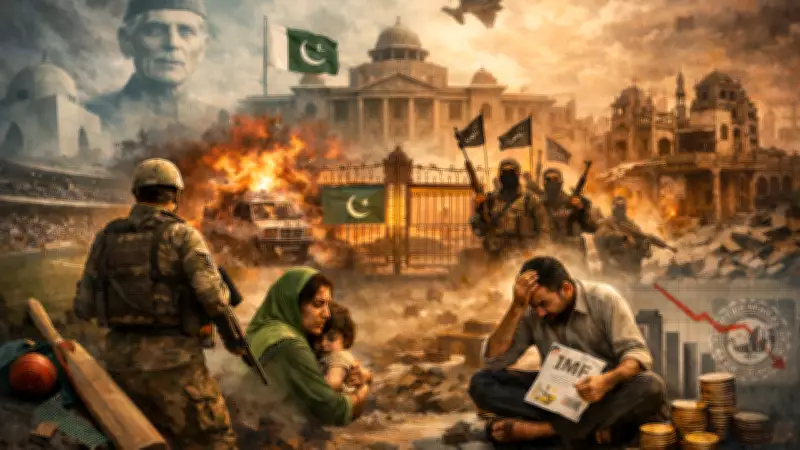
Pakistan's crises do not erupt from nowhere. They follow a script written decades ago: identity shaped by fear, power concentrated in uniform, ideology woven into law, militancy cultivated for strategy, and an economy patched up rather than rebuilt. Each shock, whether political turmoil, insurgent violence, or fiscal emergency, appears sudden but represents the latest turn of a well-worn wheel.
The question is no longer why Pakistan faces recurring instability, but whether its leaders are willing to confront the assumptions that sustain it. Can security be redefined beyond rivalry with India? Can civilian authority truly prevail? Can economic reform challenge entrenched privilege rather than protect it?
Nations are not prisoners of their origins, but they are shaped by the stories they choose to repeat. Until Pakistan rewrites its foundational narrative, crisis will remain not an interruption of its history, but its steady pulse.