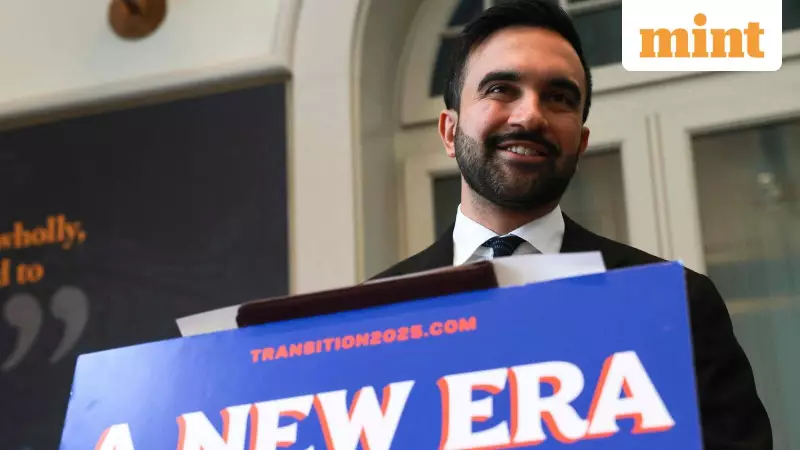
In a landmark ceremony rich with symbolism, Zohran Mamdani is set to become the Mayor of New York City, marking a series of historic firsts for the metropolis. The 34-year-old Democrat will take his oath of office at midnight inside a long-closed subway station beneath City Hall, placing his hand on a centuries-old Quran. This act will make him the first Muslim, first South Asian, and first African-born individual to hold the city's highest office.
A Ceremony of Firsts and Faith
While most of his predecessors were sworn in using a Bible, Mamdani's choice underscores his identity and the vibrant Muslim community of New York. The oath to uphold constitutions does not mandate any religious text, making his decision a powerful personal and political statement. During his campaign, which focused heavily on affordability, Mamdani was also vocal about his Muslim faith, frequently visiting mosques across the five boroughs to build a coalition that included many first-time South Asian and Muslim voters.
For the unique subway station ceremony, Mamdani will use two Qurans: his grandfather's personal copy and a pocket-sized manuscript dating back to the late 18th or early 19th century, part of the New York Public Library's Schomburg Center for Research in Black Culture. A subsequent swearing-in at City Hall on New Year's Day will feature both his grandfather's and grandmother's Qurans.

The Journey of a Historic Manuscript
The library's Quran has a remarkable history. It was acquired by Arturo Schomburg, a Black Puerto Rican historian who dedicated his life to documenting the global contributions of people of African descent. Scholars believe Schomburg's interest in the historical links between Islam and Black cultures in Africa and the United States led him to this text.
Unlike ornate religious manuscripts, this Quran is modest. It features a deep red binding with a simple floral medallion and is written in plain, readable black and red ink. Hiba Abid, the library's curator for Middle Eastern and Islamic Studies, notes these features indicate it was made for everyday use by ordinary readers, not for ceremonial display by royalty.
"The importance of this Quran lies not in luxury, but in accessibility," Abid said. Its journey to New York mirrors Mamdani's own layered identity as a South Asian New Yorker born in Uganda, married to American-Syrian Rama Duwaji, who helped select the text.
Identity, Backlash, and a Public Legacy
Mamdani's meteoric rise as a Muslim democratic socialist has not been without controversy, attracting a surge of Islamophobic rhetoric amplified by national attention. In an emotional pre-election speech, he addressed the hostility directly: "I will not change who I am, how I eat, or the faith that I'm proud to call my own," he declared.
The decision to use a Quran has drawn fresh criticism from some conservative figures, echoing the backlash faced by Keith Ellison, the first Muslim elected to Congress in 2006, when he did the same. Following the inauguration, the historic Quran will be placed on public display at the New York Public Library.
Abid hopes the ceremony's attention will encourage more people to explore the library's collections on Islamic life in New York. "This manuscript was meant to be used by ordinary readers when it was produced," she reflected. "Today it lives in a public library where anyone can encounter it." This event stands as a testament to the evolving tapestry of American leadership and the enduring power of symbolic representation.