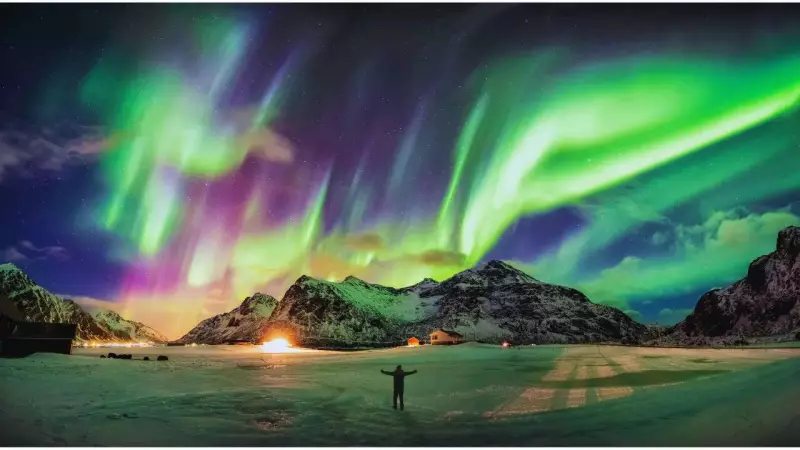
This week, the usually quiet northern skies over the United States are poised for a potential celestial spectacle. A surge of solar activity is interacting with Earth's magnetic field, creating conditions that could make the elusive Northern Lights, or aurora borealis, visible across several northern states. While not a guaranteed sight, the increased activity offers a rare winter opportunity for sky watchers.
Which US States Have the Best Chance to See the Aurora?
The highest probability, as always, lies in the far north. Alaska stands as the most reliable location for aurora viewing, almost in a league of its own. However, for this specific event, forecasters have identified a viewing zone that includes parts of the contiguous US. States with the strongest chances include:
- Washington
- Montana
- North Dakota
- South Dakota
These regions are positioned where Earth's magnetic field channels charged solar particles into the atmosphere, creating the glowing auroral displays. According to NOAA forecasts, the geomagnetic activity is expected to peak overnight between January 8 and January 9. In these prime locations, observers might witness brighter arcs or slow-moving curtains of light, rather than just faint glows, though the aurora's appearance is famously unpredictable.

Could Southern States Get a Glimpse?
For residents in states just below the typical aurora belt, there is still a sliver of hope. Areas like Minnesota, Michigan, and Maine often find themselves on the fringe during moderate solar storms, and this week could present such an opportunity. The display here, however, is usually far more subtle.
The colours may appear washed out, sometimes seeming more grey than vibrant green, and the lights will likely hover low on the northern horizon. They can easily be mistaken for distant city glow or thin clouds. Other states like Wyoming, Vermont, New Hampshire, and parts of New York also fall into this category of possible, but faint, visibility. Success here depends heavily on dark skies, patience, and sometimes a camera, which can often capture colours the naked eye misses.
What's Causing This Celestial Show?
The source of this event is our Sun. A coronal mass ejection (CME) has sent a stream of charged particles toward Earth. This stream is interacting with a co-rotating interaction region already in space, and together they are disturbing our planet's magnetic shield. The disturbance is classified as a G1-level geomagnetic storm, which is considered minor.
While 'minor' suggests less intensity, it does not mean invisible. The effects are simply more localized. Predicting space weather remains challenging, as solar wind speed and direction can change, but forecasters are monitoring the situation closely as the storm approaches.
Tips for Viewing the Northern Lights
Even with perfect solar conditions, two major obstacles can ruin the view: clouds and light pollution. Clear, dark skies are an absolute necessity. Thick cloud cover is the most common reason people miss auroral displays. The next biggest challenge is artificial light from cities and towns, which can completely wash out faint auroras.
For the best experience, head to rural areas, coastal spots, or designated dark sky parks. Allow your eyes at least 20 minutes to fully adjust to the darkness, and avoid looking at your phone screen. Remember, a camera on a tripod with a long exposure can often reveal the aurora's colours more vividly than you can see directly. This week, the night sky holds a promise—sometimes it delivers magic, and sometimes it remains empty. That very uncertainty is what makes aurora hunting so compelling.