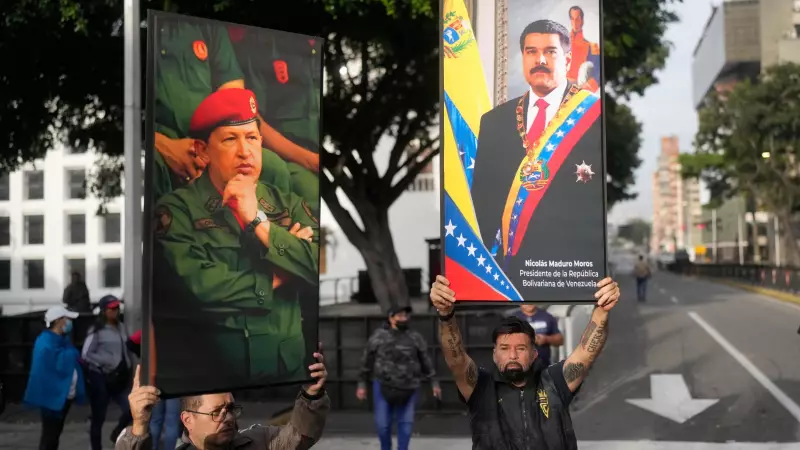
The political landscape of Venezuela has been dominated for over a decade by a figure whose origins are far from the presidential palace. Nicolás Maduro Moros, the successor to the charismatic Hugo Chávez, began his working life behind the wheel of a bus in Caracas. His journey from the city's chaotic streets to the apex of power is a tale of political loyalty, ideological fervour, and a nation's profound transformation.
The Making of a Chavista: From Union Activism to Political Protégé
Born on November 23, 1962, in Caracas, Nicolás Maduro did not come from a political dynasty. His early career was as a bus driver for the Caracas Metro system. It was here, within the transport union movement, that his political consciousness took shape. He became a dedicated union activist, fighting for workers' rights and immersing himself in leftist ideology.
This path led him directly to Hugo Chávez, the former army lieutenant colonel who staged a failed coup in 1992. Maduro was an early and fervent supporter. When Chávez was imprisoned, Maduro, alongside his future wife Cilia Flores, campaigned vigorously for his release. This loyalty would become the cornerstone of his career. After Chávez was elected president in 1998, Maduro's rise within the new political structure was swift.
He served in the constituent assembly that drafted Venezuela's new constitution in 1999. He was then elected to the National Assembly, eventually becoming its president in 2005. His most significant pre-presidential role was as Minister of Foreign Affairs from 2006 to 2013. In this position, he became the international face of Chávez's Bolivarian revolution, forging alliances with countries like Cuba, Iran, and Russia, often positioning Venezuela against United States foreign policy.
The Anointed Successor: Assuming the Mantle After Chávez
The defining moment in Maduro's life came with the death of Hugo Chávez from cancer on March 5, 2013. On his deathbed, Chávez reportedly anointed Maduro as his political heir, a powerful endorsement in a country where Chávez's cult of personality was immense. Acting as interim president, Maduro narrowly won a special presidential election on April 14, 2013, defeating opposition candidate Henrique Capriles by a margin of less than 2%.
His presidency began under the long shadow of his predecessor, and he has consistently invoked Chávez's name and legacy. However, his tenure has been defined by a severe and protracted economic and social crisis. A collapse in global oil prices, economic mismanagement, and crippling US sanctions led to hyperinflation, massive shortages of basic goods, and a humanitarian exodus of millions of Venezuelans.
Maduro's government has faced intense international pressure and allegations of authoritarianism. His re-election in 2018 was widely condemned by dozens of countries as neither free nor fair, leading to a political standoff where opposition leader Juan Guaidó declared himself interim president with Western backing. Despite this, Maduro has maintained control with the steadfast support of the military and key international allies like Cuba, Russia, and China.
A Controversial Legacy: Crackdowns, Crisis, and Control
Maduro's rule has been marked by a harsh crackdown on political dissent. Protests in 2014 and 2017 were met with strong force, resulting in numerous deaths and arrests. His government has prosecuted and jailed key opposition figures, and human rights organisations have documented widespread abuses.
Economically, his administration has attempted unorthodox measures, including launching a state-backed cryptocurrency, the Petro, and introducing new currency denominations to combat hyperinflation, with limited success. The social cost has been staggering, with widespread poverty and a collapsed public health system.
Yet, Maduro has shown remarkable political resilience. He has survived severe sanctions, diplomatic isolation from the West, and multiple attempts to force him from power. His grip on state institutions, particularly the armed forces, and the fractured state of the opposition have allowed him to endure. As Venezuela prepares for elections in 2024, the world watches to see the next chapter in the story of the former bus driver who became one of Latin America's most polarising and enduring leaders.