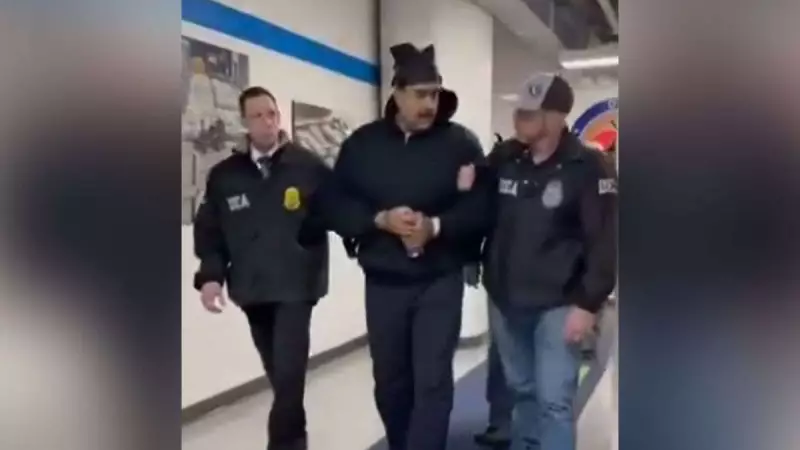
In a stunning international development, Venezuelan President Nicolas Maduro was reportedly arrested and extradited to the United States, landing in handcuffs at a US Drug Enforcement Administration (DEA) office in New York. The dramatic operation, which concluded on the night of January 4, 2026, was captured in a now-viral video where a subdued Maduro is heard uttering, "Happy New Year, good night," to officials.
The Shocking Arrest and Secret Extradition
The operation to apprehend Nicolas Maduro was a closely guarded secret, culminating in his arrival at the DEA's New York office. According to reports, the Venezuelan leader was taken into custody and swiftly transported to the United States to face long-standing charges. The US Department of Justice had previously indicted Maduro and several of his associates on serious charges, including narco-terrorism, drug trafficking, and corruption.
The pivotal moment was recorded on video, showing Maduro in custody. As he is escorted by US federal agents, he turns to them and says, "Feliz Año Nuevo, buenas noches," which translates to "Happy New Year, good night." This bizarre farewell, delivered while in handcuffs, has become the defining soundbite of the extraordinary event, highlighting the surreal nature of a sitting head of state being brought to another country to face justice.

Background of US Charges Against Maduro
The path to this moment began years earlier when US prosecutors unsealed indictments against Nicolas Maduro. The allegations were grave, accusing him and his inner circle of turning Venezuela into a narco-state and collaborating with the FARC guerrilla group in Colombia to flood the United States with cocaine. The US government had offered a substantial reward of up to $15 million for information leading to his arrest and conviction.
For years, Maduro had dismissed these charges as a political ploy and an attempt at regime change by Washington. His sudden appearance in New York suggests a covert operation that bypassed traditional diplomatic channels, raising immediate questions about the circumstances of his departure from Venezuela and which authorities, if any, facilitated it.
Immediate Repercussions and Global Reaction
The arrest of President Maduro is set to trigger a profound political and constitutional crisis in Venezuela. The country is likely to witness significant internal turmoil as power dynamics shift abruptly. Internationally, reactions are expected to be sharply divided. While the United States and its allies may hail it as a victory for the rule of law, other nations, including allies of Caracas like Russia, Cuba, and Iran, are likely to condemn the action as a violation of international sovereignty.
The event marks an unprecedented moment in modern geopolitics. It is rare for a sitting head of state to be extradited to face criminal charges in another country. The legal proceedings in a US federal court will now become a global spectacle, scrutinized for their fairness and their political implications. The case will test international legal norms and could set a controversial precedent for how powerful nations pursue justice against leaders of adversarial states.
As the world digests this news, all eyes are on Venezuela's next moves and the formal commencement of judicial proceedings against Nicolas Maduro in a New York courtroom. The video of his arrival, with its chillingly casual New Year's greeting, will undoubtedly be replayed as a historic artifact of a leader's dramatic fall from power.