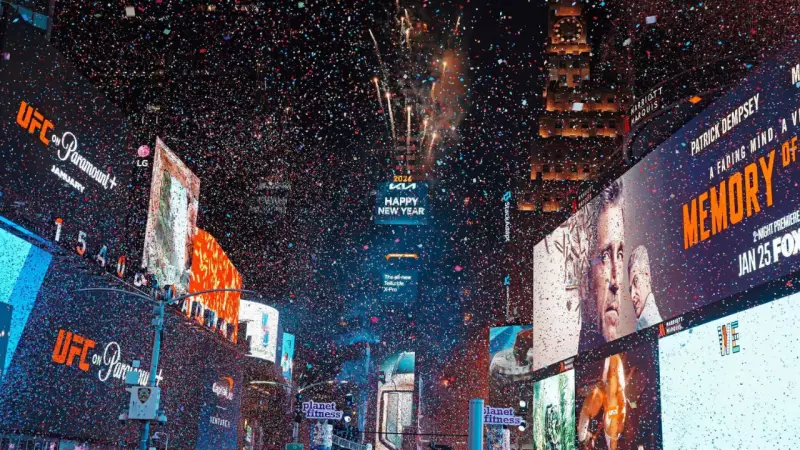
New York City welcomed the year 2026 with its iconic blend of tradition and dazzling spectacle, as the world-famous Times Square ball drop illuminated the night sky and screens across the globe. This year's celebration marked a historic milestone with the debut of the largest New Year's Eve ball in the event's long history.
A New Chapter in a Century-Old Tradition
For the first time, the celebrations were centered around the Constellation Ball, a monumental new symbol that replaced its predecessors. As reported by CNN, this new orb measures an impressive 12.5 feet in diameter and weighs over 12,000 pounds, signifying a fresh chapter for a tradition that began back in 1907. It is the ninth ball to grace the pole above One Times Square.
The design of the Constellation Ball is a feat of engineering and artistry. It is adorned with 5,280 individual Waterford crystal panels crafted in three distinct circular sizes, complemented by thousands of energy-efficient LED lights. In a significant design shift, organisers moved away from the triangular crystals used in earlier versions. The new circular shapes were chosen to symbolise interconnectedness, continuity, and collective optimism for the future.

"The ball is meant to represent interconnectedness, wholeness, and the cyclical nature of tradition, celebrating the eternal relationship between the past, present, and future," explained Michael Phillips, president of Jamestown, the firm that owns and operates One Times Square. The massive structure was hoisted into position in November and underwent weeks of rigorous testing to ensure a flawless performance.
A Global Countdown Amid Tight Security
As the clock neared midnight, the brilliantly lit ball began its slow, minute-long descent at 11:59 pm. A massive crowd, braving cold and blustery weather, packed the crossroads of Midtown Manhattan, while millions more watched the live broadcast. The traditional 60-second countdown culminated in roaring cheers, a blizzard of confetti, and celebratory embraces as 2026 officially commenced.
The event, which is New York City's largest annual gathering, required extensive security planning. New York Police Commissioner Jessica Tisch confirmed a heightened police deployment for the festivities, as reported by the New York Times. Street closures began early on Wednesday morning, transforming much of Midtown into a pedestrian-only zone for the revelers.
Visitors from across the planet gathered to witness the moment. "Everywhere is freedom," said Soyeon Kim, a visitor from South Korea. "It's so nice, the decorations, the colors, the lights."
Political Transition and Historical Roots
This year's celebration also carried political significance for the city. Outgoing Mayor Eric Adams had the honour of pressing the button to initiate the famous countdown, marking the end of his tenure. Shortly after the new year began, Zohran Mamdani was sworn in as the new mayor of New York City.
The tradition of the Times Square ball drop itself has fascinating origins. It was introduced over a century ago after city officials banned fireworks from New Year's celebrations. Newspaper publisher Adolph Ochs then commissioned a metalworker, Jacob Starr, an immigrant from Ukraine, to create a safe yet stunning visual spectacle to attract crowds.
Inspired by 19th-century nautical timeballs used by sailors to set their chronometers, the first Times Square ball was a simple iron-and-wood sphere fitted with light bulbs. From that humble beginning, it has evolved over the decades into a universally recognised symbol of hope and new beginnings, ringing in each new year for a global audience.