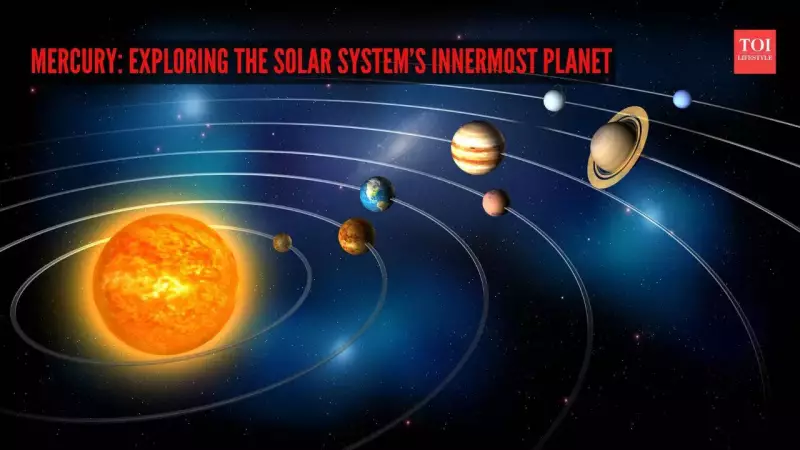
While scrolling through trending topics from heart health quotes to Bollywood stars, many might overlook the celestial wonders right in our cosmic backyard. Mercury, the solar system's innermost planet, presents one of the most fascinating studies in planetary science despite its small stature.
The Extreme World Next Door
Mercury holds the distinction of being both the closest planet to the Sun and the smallest among the eight major planets in our solar system. Orbiting at an average distance of approximately 58 million kilometers (0.39 AU) from the Sun, this tiny world experiences sunlight that appears over three times larger and seven times brighter than what we see from Earth.
With a mean radius of roughly 2,440 kilometers, Mercury is only slightly larger than Earth's Moon. This compact size makes it the smallest primary planet, yet it hosts some of the most dramatic environmental conditions known to astronomers.

Temperature Extremes and Orbital Wonders
The planet's proximity to the Sun and its virtually non-existent atmosphere create staggering temperature variations. During Mercury's daytime, surface temperatures can reach scorching highs of about 430°C (800°F), hot enough to melt lead. When night falls, or in permanently shadowed regions, temperatures plummet to bone-chilling lows of -180°C (-290°F).
Mercury's orbital characteristics are equally remarkable. The planet completes its journey around the Sun in just 88 Earth days, making its year the shortest of all planets. It travels at nearly 47 kilometers per second, faster than any other planet in our solar system.
Surprising Daily Cycles and Internal Structure
Despite its rapid orbit, Mercury experiences incredibly long days. The planet rotates on its axis once every 59 Earth days, but due to its orbital motion, a full day-night cycle from sunrise to sunrise lasts approximately 176 Earth days. This means a single day on Mercury is nearly twice as long as its year.
Unlike Earth and many other planets, Mercury travels alone through space without any natural moons or ring systems. However, its internal structure reveals surprising complexity. Mercury is the second-densest planet after Earth and contains a massive, iron-rich core that occupies about 85% of its radius - a much larger proportion than other terrestrial planets. Scientists believe this core may be partly molten.
According to NASA Science, these seven facts highlight why Mercury, despite its small size and extreme conditions, remains a world of significant scientific interest that continues to reveal secrets about planetary formation and evolution in our solar system.