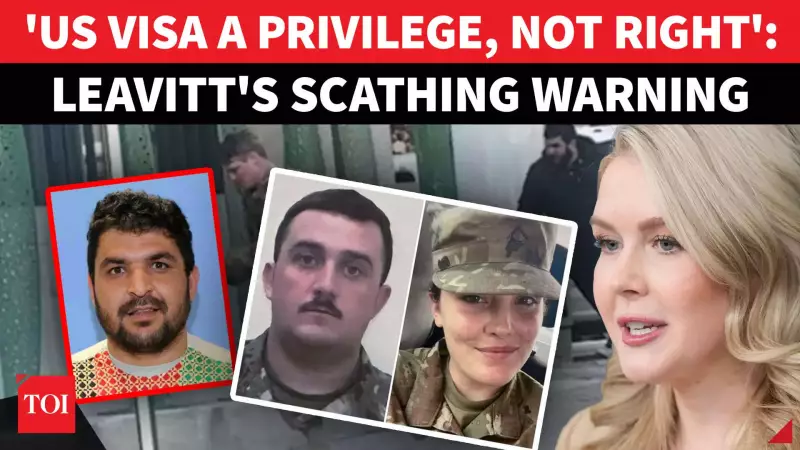
In a fiery intervention that has reignited America's contentious immigration debate, spokesperson Karoline Leavitt delivered a stark message: a U.S. visa is a privilege, not a fundamental right. Her remarks, made in the wake of a deadly attack in Washington D.C., place national security and stringent vetting at the forefront of the political conversation.
Visa as a Privilege: A Core Policy Shift
Leavitt argued forcefully that the United States must prioritize its own safety above political correctness. Central to her argument is the power to revoke visas when individuals are found to be acting against U.S. interests. She contended that the country cannot afford to continue admitting refugees or immigrants who might later exploit the very system designed to offer them sanctuary and opportunity. This stance represents a significant hardening of rhetoric around immigration policy, framing it as a conditional grant of entry that can be withdrawn.
The Minnesota Fraud Case: A Systemic Red Flag
To underscore her point about systemic abuse, Leavitt pointed to a major fraud case unfolding in Minnesota. The case involves charges against 86 individuals, with 78 of them identified as Somali nationals. This figure, she emphasized, is not just a statistic but a glaring indicator of potential flaws in screening processes and challenges related to assimilation. The case raises urgent questions about the mechanisms in place to prevent such large-scale exploitation and the ongoing debate about national identity.

Rekindling a National Debate
Leavitt's comments have effectively poured fuel on the long-smoldering fire of America's immigration discussion. The core questions she brings back to the spotlight are fundamental: Who gets to enter the United States? Who is allowed to stay? And critically, are there individuals or groups taking undue advantage of the nation's historical generosity? Her message resonates with a segment of the population concerned about security and the integrity of immigration systems, ensuring the debate will remain heated in the coming political cycle.
The broader context includes related political reactions, such as pointed comments about Congresswoman Ilhan Omar and the geopolitical tensions surrounding Ukraine and Russia, highlighting how immigration is often intertwined with wider national and international policy disputes.