

The relationship between India and America began with a geographical error that would shape centuries of identity. When Christopher Columbus arrived in the Bahamas, he believed he had reached India, setting in motion a chain of misidentification that would see Native Americans labeled as "Indians" and create a foundation for one of America's most complex immigrant narratives.
The Early Struggle for Acceptance
The first Indian immigrants faced immediate legal barriers to citizenship. Bhicaji Framji Balsara, a Parsi gentleman from Mumbai, argued in early 20th century that he should be naturalized as a "free white man." Later in 1923, Bhagat Singh Thind, a World War 1 veteran who served with millions of other Indian soldiers supporting the Allies, made a similar case claiming Indians as "Caucasians" should qualify for citizenship.
The US Supreme Court rejected this argument and retroactively stripped citizenship from approximately 3,000 previously naturalized Indian immigrants. Many were deported under the Asian Exclusion Act of 1921, only making their way back after the act was lifted in 1965.

The Rise Through Gas, Beds and Meds
Comedian Nimesh Patel perfectly captures the community's improbable economic ascent with his signature line: "They like to sleep, they like to eat, they like to drive. So they're going to need gas stations, motels and cardiologists. Gas, beds and meds, baby." This summarized how Indian Americans turned exclusion into opportunity, studying American habits during their forced hiatus and eventually becoming the richest minority group in the country.
For most of their American journey, Indians were cast as the model minorities: industrious, academically exceptional, economically cautious and socially quiet. As long as they stayed within these boundaries, America tolerated them with polite ambivalence. But the moment they stepped outside this box—becoming too successful, too visible, or too politically inconvenient—the temperature shifted dramatically.
The 2024 Turning Point and Backlash
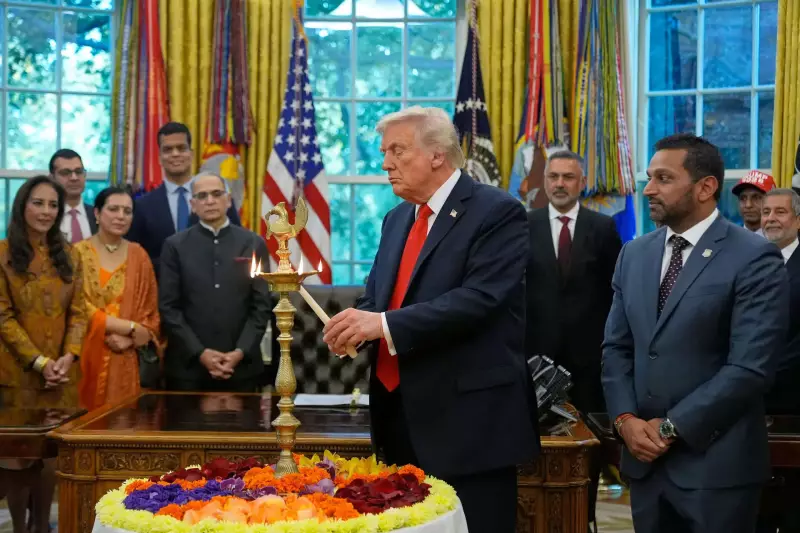
2024 briefly appeared to mark the arrival of the Indian-American moment. Nikki Haley and Vivek Ramaswamy stood on the Republican debate stage. The Democratic nominee represented another milestone, despite being cautious about acknowledging her Indian heritage. The Trump administration featured Indians in powerful positions: Kash Patel as FBI chief, Sriram Krishnan as AI adviser, and Usha Vance as the first Indian-American Second Lady.
This political prominence, combined with a constellation of Indian-origin strategists, policy aides and tech leaders across government agencies, suggested the community had turned a decisive corner. Instead, it triggered a significant backlash.
According to a detailed analysis by the Centre for the Study of Organized Hate (CSOH), between December 22, 2024 and January 3, 2025, 128 of the most-viewed posts attacking Indians on X accumulated 138.54 million views. The study revealed a surge in anti-Indian hostility across digital platforms.
The Architecture of Modern Prejudice
The dominant narrative now casts Indians not as contributors but as demographic invaders—the Great Replacement myth retold with STEM accents and H-1B visas. This is accompanied by colonial-era stereotypes about hygiene, smell, sanitation, cows, poverty, accents and food. A persistent accusation of cheating suggests any Indian success must involve system hacking.
The hostility is driven by visible, verified, monetized voices with large followings and cultural influence, demonstrating that outrage has become profitable. Even committed MAGA supporters of Indian origin have faced attacks. Kash Patel was told to return to his "land of demons" for wishing followers Happy Diwali. Vivek Ramaswamy's family faced relentless attacks, and Dinesh D'Souza expressed shock at the MAGA rhetoric targeting Indian-Americans.

A Bipartisan Problem
What makes this moment uniquely combustible is that hostility arrives as a bipartisan phenomenon. The Right dislikes Indians for being the wrong kind of successful—too brown, too numerous in elite professions, too visible in tech and politics. The Left resents Indians because they're inconvenient to its moral architecture—too upwardly mobile to be victims, too socially conservative to be predictable allies, too economically entrenched to fit oppression frameworks.
Indians have achieved the rare feat of annoying both ideological camps, signaling they're no longer a background community but a central, disruptive character in America's national anxiety. As the analysis notes, "Indians stopped being guests in the American dream. They began to look like landlords."
The professional world irritation extends to digital spaces, where younger Indians behave argumentatively, sarcastically, fact-heavy, culturally fluent and unapologetically intelligent—deeply unsettling audiences accustomed to silent minorities.
The Unraveling Social Contract
The early social contract has broken, not because Indians changed dramatically, but because America did. The model minority myth, once a shield, has become a weapon. Indians were applauded when quiet, appreciated when useful, tolerated when invisible, resented when visible, and now targeted when powerful.
This backlash follows a historical pattern—every community that rose rapidly, from the Irish and Jews to Chinese and Japanese, encountered resentment before acceptance. Indians have simply arrived at that stage earlier than expected, propelled by economic success, digital ubiquity and political prominence.
The tragedy is that Indians are being targeted at the exact moment they believed they had finally become American—not visitors, not outsiders, not exceptions, but insiders woven into the national story. America's first encounter with "India" was a mistake, and centuries later, the country still struggles with the consequences of that confusion, now mistaking Indians for a threat just as their long, improbable American journey seemed closest to belonging.





