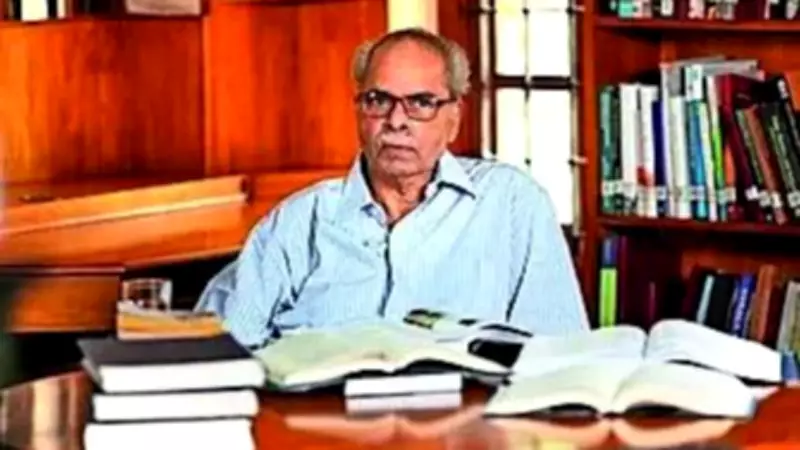
Eminent Historian K N Panikkar, Pioneer of Cultural Studies in Modern India, Passes Away
Noted leftist historian K N Panikkar, a distinguished scholar who critiqued colonial historiography's simplistic view of culture and highlighted how indigenous intellectuals offered an alternative paradigm of modernity, passed away at a private hospital in Thiruvananthapuram on Monday. He would have turned 90 next month, marking a significant milestone in a life dedicated to reshaping historical understanding.
A Legacy of Intellectual Rigor and Pedagogical Excellence
Panikkar, affectionately called KN by his colleagues, belonged to a select group of historians such as Bipan Chandra, Sabyasachi Bhattacharya, and S Gopal, who created a strong department of modern Indian history at JNU's Centre for Historical Studies. His pioneering course on the history of ideas in India in the 19th century broke new ground in academic circles.
Salil Misra, a modern India historian, reflects on Panikkar's contributions: "Panikkar taught at a time when history writing was dominated by economic and political concerns. He endeavoured, through his research, to claim a position of centrality for culture as an important ingredient both in human action and large political movements." This emphasis on cultural dimensions set him apart from his contemporaries.

Championing Indigenous Modernity and Knowledge Systems
Historian Rakesh Batabyal adds that Panikkar brought to attention how the ideas of Akshay Kumar Dutt, Lokahitawadi, and other 19th-century intellectuals needed no western validation: they were modern in their own right and gave us a sense of the new world opening before us. "When he discussed the tradition of knowledge in Ayurveda, we began to understand the complexities of the Indian knowledge processes under colonialism," Batabyal notes, underscoring Panikkar's role in reclaiming indigenous intellectual heritage.
Modern India historian Aditya Mukherjee, who was both a student and colleague of Panikkar, shares: "He acquired the reputation of a great teacher when he taught in a college in Delhi University and was invited to join JNU in 1972. He was a brilliant teacher who taught us social and religious reforms in the 19th century, making the subject come alive even to students like me who had no background in history, having graduated in economics." This pedagogical skill made him a beloved figure among diverse student bodies.
Personal Journey and Academic Contributions
Born in Guruvayoor, Panikkar left Kerala after completing his undergraduate studies and went on to earn his Master's degree and doctorate from Rajasthan University, where he later married his college mate, the late Usha Bhargava. He also served as the founding vice-chancellor of Sree Sankaracharya University of Sanskrit, Kalady, further cementing his commitment to Indian knowledge systems.
Among his notable books is "Against Lord and State: Religion and Peasant Uprising in Malabar." Kerala Chief Minister Pinarayi Vijayan, in his condolence message, highlighted: "His role in presenting Malabar rebellion in its true historical context and highlighting its aspects as a freedom struggle, agrarian revolt, and anti-imperialist movement is of historical significance."
Engaging with Diverse Perspectives and Encouraging Dissent
R Mahalakshmi, an eminent historian of South India, observes: "He was a proud Marxist, yet he engaged with questions perceived as outside the mainstream of Marxist ideology, as seen in his important essay 'Culture and Consciousness in Modern India.'" This openness to varied viewpoints was a hallmark of his intellectual approach.
Historian M G Sashibhooshan endorses this view, recalling: "I remember Panikkar accepting my request to present a paper on Pattanam at the History Congress, despite knowing that my opinion on Pattanam (Muziris) was different from that of Marxist historians." Such inclusivity fostered rich academic debates.

Misra further recalls Panikkar encouraging his students to disagree with him: "It was believed that he was more likely to reward dissenting ideas with higher grades than those that simply conformed to his ideas. His classrooms became contestatory spaces in which he was not the only voice. Many other students offered their own ideas, and he warmly endorsed all of them." This nurturing of critical thinking left a lasting impact on generations of scholars.