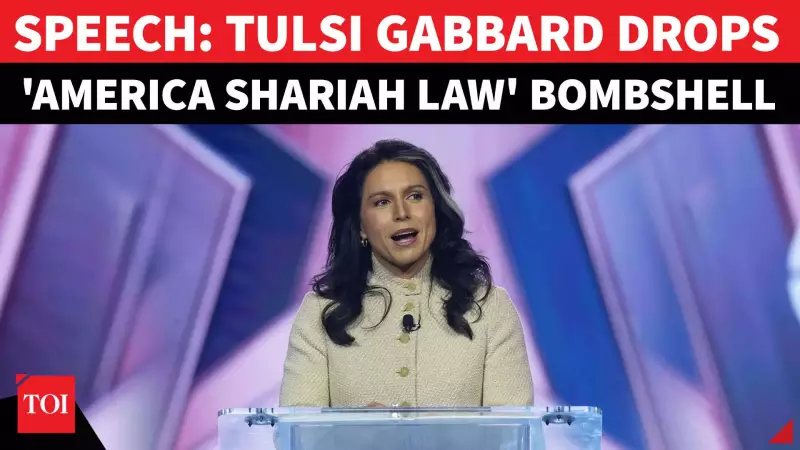
In a stark address that has ignited debate across the nation, United States Director of National Intelligence Tulsi Gabbard issued a forceful warning about the rising global influence of Islamist ideology. Delivering her remarks recently, the intelligence chief framed the issue as a direct challenge to the core principles of Western democracies, particularly the United States.
Gabbard's Core Warning: Ideology vs. Freedom
The former congresswoman drew a clear distinction between the religion of Islam and what she termed "Islamist ideology." She characterized this ideology not as a faith but as a political movement that actively rejects concepts of individual liberty and personal freedom. Gabbard argued that this worldview is fundamentally at odds with the founding ideals of the American republic, making its growth a matter of urgent national security concern.
"This ideology stands in direct opposition to the foundational principles of freedom and liberty on which the United States was built," Gabbard stated, emphasizing its fundamental incompatibility with American values. Her comments have placed a renewed spotlight on the ongoing discussion about security, ideology, and integration within Western societies.

European Security Concerns as a Case Study
To underscore the immediacy of the threat, Gabbard pointed to recent security developments in Europe. She specifically cited instances in Germany where traditional Christmas markets have been canceled due to elevated security concerns linked to potential extremist threats. This real-world example, she suggested, illustrates how the influence of radical ideologies can tangibly impact cultural traditions and public safety in free societies.
By highlighting these events, the Director of National Intelligence connected international trends to the domestic security landscape of the US, suggesting that the patterns observed abroad could manifest at home if left unaddressed.
Reactions and the Road Ahead
Gabbard's speech, delivered on December 21, 2025, has predictably generated strong reactions. Supporters have applauded her for directly naming a security challenge they feel is often overlooked, while critics caution against rhetoric that could unfairly stigmatize Muslim communities. The debate touches deep nerves concerning immigration, national identity, and the balance between security and civil liberties.
As the nation's top intelligence official, Gabbard's words carry significant weight and are likely to influence policy discussions within the Trump administration. Her framing of Islamism as an ideological battle, rather than solely a counter-terrorism operation, sets a distinct tone for how the US intelligence community might prioritize and articulate this threat moving forward. The full implications of her warning, and the policy responses it may trigger, remain to be seen.