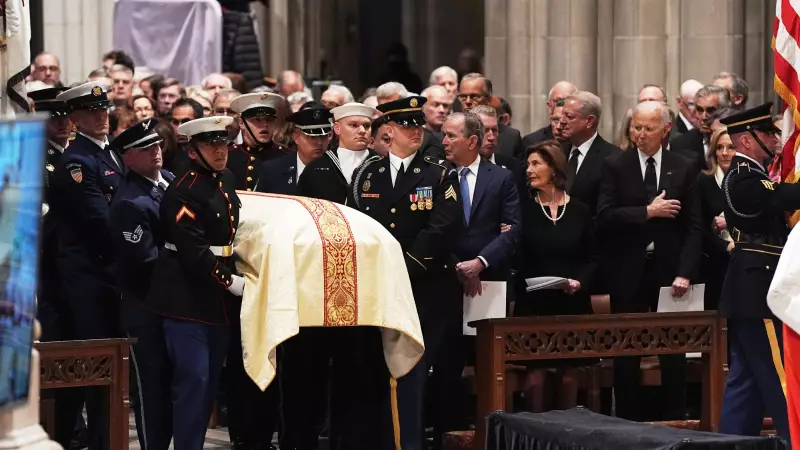
Washington witnessed a remarkable gathering of political heavyweights as former Vice President Dick Cheney was laid to rest in a ceremony that brought together leaders from across the political spectrum. The funeral service, held at Washington National Cathedral, saw current and former presidents paying their respects to the influential Republican figure who served under George W. Bush.
Political Leaders Unite in Tribute
The ceremony attracted an impressive roster of political dignitaries, highlighting Cheney's significant impact on American politics. President Joe Biden and Vice President Kamala Harris represented the current administration, setting aside political differences to honor the former vice president. Former President George W. Bush, under whom Cheney served for two terms from 2001 to 2009, delivered a heartfelt eulogy for his longtime colleague and friend.
The gathering included numerous prominent figures from both major political parties, creating a rare moment of bipartisan unity. Former Secretary of State Hillary Clinton, former House Speaker Paul Ryan, and Senate Minority Leader Mitch McConnell were among the distinguished attendees. The presence of these leaders underscored Cheney's enduring influence in Washington political circles despite his controversial tenure.

Notable Absences and Political Implications
Perhaps the most discussed aspect of the funeral was the absence of former President Donald Trump. Multiple reports confirmed that Trump had not received an invitation to the service, reflecting the strained relationship between the two Republican figures. This exclusion speaks volumes about the ongoing divisions within the Republican Party.
Also absent was Ohio Senator JD Vance, a prominent Trump ally who has emerged as a potential vice presidential candidate. The guest list appeared carefully curated to exclude those representing the more populist, America First wing of the Republican Party that Trump continues to lead.
The selective invitations highlight the continuing rift between establishment Republicans, represented by figures like Cheney and the Bush family, and the Trump-led faction that has dominated the party in recent years. This division has become increasingly pronounced since the January 6 Capitol riots and Cheney's subsequent role on the House committee investigating the events.
Cheney's Legacy and Family Presence
Dick Cheney's family played a central role in the funeral proceedings, with his daughter Liz Cheney, the former Wyoming representative, attending alongside other family members. Liz Cheney's recent political career has been defined by her strong opposition to Donald Trump, which ultimately cost her House leadership position but cemented her status as a principled conservative voice.
The former vice president, who passed away at age 93, served as defense secretary under President George H.W. Bush before assuming the vice presidency. His tenure was marked by significant events including the September 11 attacks and the subsequent wars in Afghanistan and Iraq. Cheney was known for his hawkish foreign policy views and expansive interpretation of executive power, positions that made him both respected and controversial.
The funeral service provided an opportunity for reflection on Cheney's substantial impact on American foreign policy and national security apparatus. His influence extended well beyond his time in office, with his views continuing to shape conservative thinking on national security matters.
Washington National Cathedral, the venue for the service, has historically hosted state funerals for numerous American leaders, including several presidents. The choice of location underscored the significance accorded to Cheney's contributions to American political life, despite the controversies that marked his career.
The gathering of political leaders from different eras and affiliations served as a reminder of Washington's capacity for ceremonial bipartisanship, even in an era of deep political polarization. The event demonstrated that despite fundamental disagreements on policy and approach, the capital's political class can still unite to honor one of their own.