CIA Announces Sunset of World Factbook After More Than Six Decades
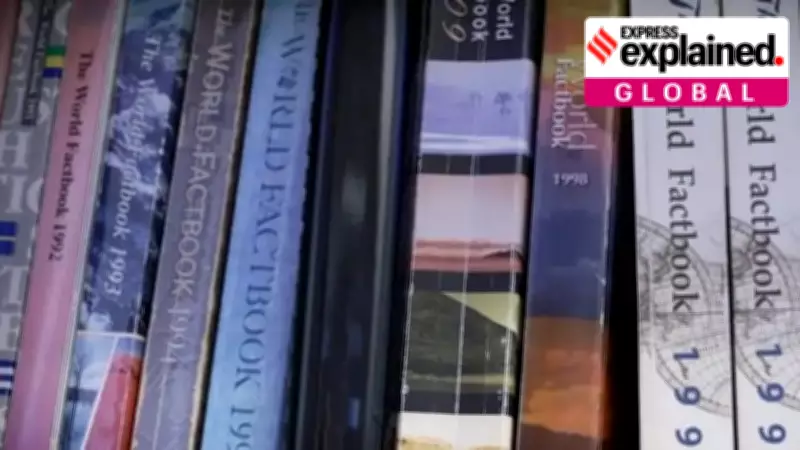
On February 4, 2026, the US Central Intelligence Agency (CIA) declared the end of its renowned reference manual, the CIA World Factbook, following a service spanning over sixty years. In an official statement, the foreign intelligence agency described the Factbook's "sunset," highlighting its role as a longstanding, one-stop basic reference for both the Intelligence Community and the general public regarding countries and communities worldwide.
Public Outcry and Nostalgic Memories
Following the announcement, widespread dismay emerged across social media platforms, with numerous users sharing nostalgic anecdotes of utilizing the manual for research purposes prior to the internet's ubiquity. As noted on the CIA website, "Before there was a Wikipedia to search on, before there was a Bing to consult, and most certainly before 'Google' became a verb, there was CIA's World Factbook." This sentiment underscores the manual's transformation from a classified spy tool to an invaluable public resource.
Historical Origins and Evolution
Although the World Factbook began publication in 1962, its origins trace back to World War II. In 1943, amidst battles against the Axis Powers, the US administration under President Franklin D. Roosevelt reflected on the intelligence failure leading to the Pearl Harbor attack. This prompted the creation of the Office of Strategic Services (OSS), the CIA's precursor, led by General William Donovan, who oversaw basic intelligence collection.

The CIA explains basic intelligence as the foundational layer of the intelligence pyramid, essential for building other forms of intelligence. Post-war, the OSS collaborated with military intelligence to establish the Joint Army Navy Intelligence Studies (JANIS), the first interdepartmental basic intelligence program, which published 34 studies between 1943 and 1947.
Post-War Development and Public Access
After WWII, national security expert George S. Pettee advocated for a more comprehensive basic intelligence framework in his 1946 book, The Future of American Secret Intelligence. In 1947, the CIA was formed and took over the JANIS program, renaming it the National Intelligence Survey. The Factbook's initial 1962 version was classified as The National Basic Intelligence Factbook, but in 1971, an unclassified edition was launched, becoming publicly available in 1975. It was renamed The World Factbook in 1981 and went online in 1997, serving as a free public resource until its recent shutdown.
Significance and Contributions
Over time, the Factbook became an essential resource for the US Government, academic institutions, and private citizens, providing timely and accurate reference materials. Many CIA officers contributed personal travel photos, resulting in over 5,000 copyright-free images accessible to all. This democratization of information made it a cornerstone for global understanding.
Reasons for Shutdown and Political Context
The CIA did not specify reasons for the closure in its announcement, but it likely stems from current CIA chief John Ratcliffe's commitment to terminate programs not advancing the agency's core missions. In May 2025, the Associated Press reported that the Donald Trump administration planned to reduce the CIA workforce by 1,200 over several years, with Ratcliffe aligning the agency with Trump's national security priorities.
David A. Graham, a staff writer for The Atlantic, noted that the Factbook's demise is part of a broader war on information by the Trump administration, involving steps that block data access and erode a shared informational framework for Americans. In this context, the Information Age's biggest casualty appears to be information itself, with the Factbook becoming an unwitting victim of domestic political upheaval.
Legacy and Impact
The CIA World Factbook's closure marks the end of an era where intelligence transitioned from exclusive spy material to a public good. Its shutdown raises concerns about the future of accessible, factual information in an increasingly polarized political landscape, highlighting how information can become collateral damage in broader conflicts.