

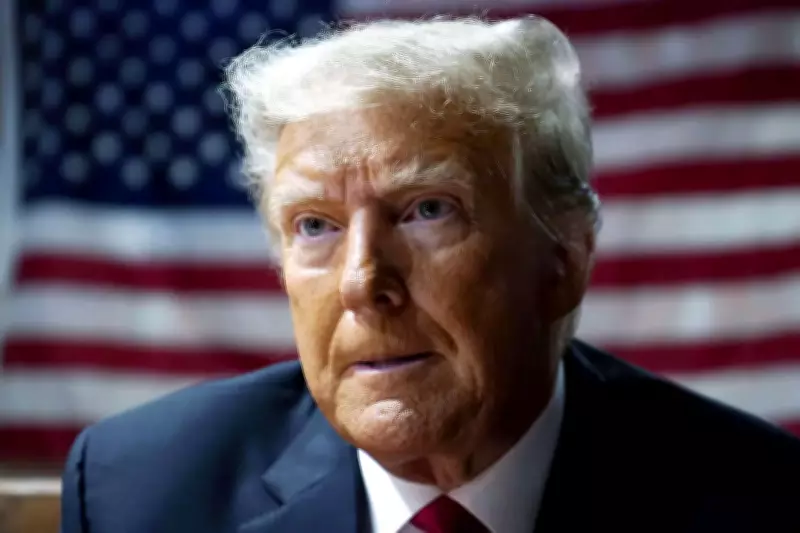
US President Donald Trump announced on Thursday that he had called off planned military strikes against Iran, just hours after warning of a major escalation that included taking control of the country's oil industry. In a social media post, Trump stated that the decision was made 'based on the fact that discussions with the Islamic Republic of Iran have been brought to the highest level of Iranian leadership and approved.'
Escalation and Reversal
The announcement followed two days of exchanges between US and Iranian forces that had raised concerns about the Middle East sliding back into a wider conflict. Earlier in the day, Trump declared that the United States would strike Iran 'VERY HARD TONIGHT' and would assume 'total control' of the country's oil and gas sector. By evening, however, he expressed renewed optimism about efforts to preserve the fragile ceasefire.
Trump stated that 'discussions and final points have been, in both concept and great detail,' approved by the United States, Israel, and other regional partners. He did not provide further details about the reported progress.

Background of Tensions
Over recent weeks, Trump has repeatedly suggested that a breakthrough agreement between the parties was close, though no final settlement has emerged. His latest threats reflected growing frustration with the slow pace of negotiations. Earlier this week, he warned that Tehran would 'pay the price' if it continued to delay reaching an agreement.
Iranian parliamentary speaker Mohammad Bagher Qalibaf responded on Thursday with a social media post warning that 'wrong strategies and impulsive decisions' could destabilize global energy markets and 'create an endless quagmire that you will be stuck in for years.'
Military Posturing
Although the latest military actions have heightened tensions across the region, they have remained more limited than the fighting seen during the opening phase of the conflict. Diplomatic contacts between Washington and Tehran are continuing.
Thursday's remarks marked the latest in a series of increasingly forceful statements from Trump regarding Iran. In April, he warned that 'a whole civilization will die tonight, never to be brought back again' unless Iran accepted his conditions, before later extending a ceasefire.
Focus on Kharg Island
One of Trump's most striking threats involved Kharg Island, the key hub of Iran's oil exports. Iran's prolonged restrictions on shipping through the Strait of Hormuz have disrupted global energy supplies, pushed fuel prices higher, and contributed to rising costs for consumers far beyond the region.
Trump suggested that the United States could take control of Kharg Island, through which around 90 percent of Iran's oil exports pass. Situated across the Persian Gulf from American military facilities in Kuwait and Saudi Arabia, the island plays a critical role because much of Iran's coastline is too shallow to accommodate large oil tankers.
Whether Trump intended the proposal as a serious military objective remained uncertain. 'My preference has always been to take Kharg Island,' Trump said during an interview with Fox News. 'I don't know that America has the stomach for it to be honest.'
Military Analysis
Military analysts note that any US force stationed on the island would be highly exposed because of its proximity to the Iranian mainland, only about 33 kilometers away. Missiles, drones, and artillery could be launched from the coast with relative ease.
Despite his comments, Trump indicated that he remained reluctant to commit American ground troops to a prolonged campaign inside Iran. 'I don't want to have boots on the ground,' Trump said. 'But if I wanted to we could put a small group of soldiers and take over the place.'
Trump compared the idea of taking control of Iran's oil infrastructure with what he described as the United States' assumption of control over Venezuela's oil sector after the capture of then-president Nicolas Maduro in January.






