

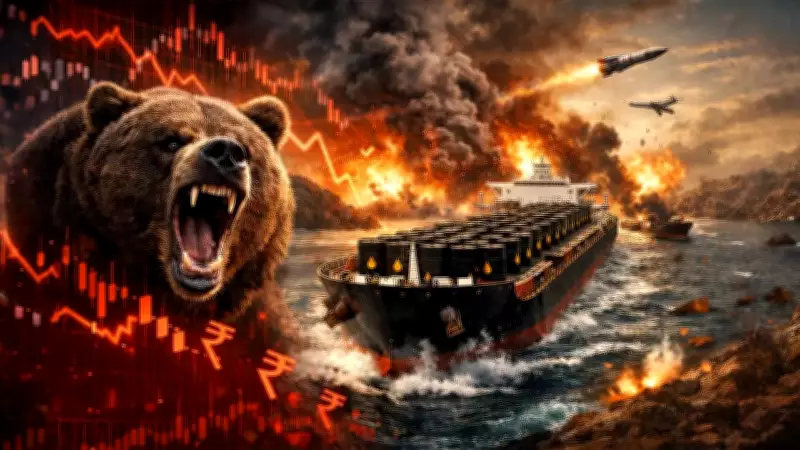
Global Energy Markets in Turmoil Following Iranian Attack on Qatar's LNG Hub
The escalating conflict in the Middle East has triggered what energy experts are calling an "Armageddon scenario" for global energy markets. Iran's targeted missile strikes on Qatar's massive Ras Laffan liquefied natural gas (LNG) complex have created unprecedented disruption to global energy supplies, with immediate and severe consequences for Europe and Asia.
Unprecedented Attack on Critical Energy Infrastructure
In a two-stage assault that began late Wednesday and continued into early Thursday, Iranian forces launched ballistic missiles at the Ras Laffan industrial complex—the world's largest LNG facility. This sprawling industrial hub, developed over three decades at a cost of hundreds of billions of dollars, normally supplies approximately one-fifth of global LNG demand.
The scale of operations at Ras Laffan is staggering: The facility operates 14 liquefaction trains that process 77 million tonnes of LNG annually—enough to meet Japan's entire yearly energy needs or exceed the combined requirements of the United Kingdom and Italy.

Immediate Market Shockwaves
The attack sent immediate shockwaves through global energy markets. Brent crude prices briefly surged over 10 percent, crossing the $119-per-barrel threshold before easing slightly. European gas prices spiked as much as 35 percent, stabilizing at around 70 euros per megawatt hour—still reflecting a 28 percent gain that will inevitably translate to higher electricity costs across the continent.
"We are not yet in the worst-case scenario we described in our last monthly report, but we are getting closer," analysts at EnergyScan told AFP.
European gas prices have more than doubled since the US-Israel-Iran conflict began, as traders assess the implications of prolonged disruption to Qatar's LNG exports.
Long-Term Damage and Economic Consequences
QatarEnergy, the state-owned operator of Ras Laffan, confirmed that damage to two LNG units—developed in partnership with ExxonMobil—could require three to five years for complete repair. This disruption has effectively removed about 17 percent of Qatar's overall gas output for the foreseeable future.
The economic impact is substantial: The facility faces annual revenue losses of approximately $20 billion and will likely force the cancellation of long-term supply agreements with Italy, Belgium, Korea, and China.
"This has always been my nightmare scenario, my Armageddon scenario, the one I didn't want to happen," said Anne-Sophie Corbeau, former head of gas analysis at BP and now with Columbia University's Center on Global Energy Policy, in an interview with the Financial Times.
Global Energy Landscape Transformed
The attack fundamentally alters global energy dynamics. Europe, already dependent on LNG after Russia curtailed pipeline exports during the Ukraine conflict, now faces intensified competition with Asian nations like Japan and South Korea for limited LNG cargo availability.
One trader told the Financial Times that European gas prices are likely to remain elevated "through 2027," while the region could struggle to replenish storage levels over the summer as Asian buyers turn to US LNG to offset the shortfall.
Tom Marzec-Manser, an LNG specialist at energy consultancy Wood Mackenzie, emphasized that "a resumption of normal production from Qatar is not going to happen in a matter of weeks" regardless of when the conflict ends. Earlier projections suggesting production could resume within 40 days are no longer realistic.
Broader Economic and Political Implications
The crisis extends beyond immediate price spikes. Qatar's ambitious expansion plans for Ras Laffan—which included adding six new liquefaction units over this year and next—are now likely to face significant delays.
Several countries have already begun reverting to coal-based power generation, while industrial operations in parts of Southeast Asia are being forced to scale back or suspend production due to limited energy availability.
"The world of energy is going to fracture between the haves and the have-nots," said Laurent Segalen, a clean energy investment banker, who described the coming months for gas importers as "a bloodbath."

Although some LNG projects in the United States are expected to come online soon, replacing Qatari supply involves significant political challenges. Some policymakers have already begun advocating for easing restrictions on Russian gas imports, highlighting the difficult choices facing energy-dependent nations.
The attack on Ras Laffan represents more than a temporary disruption—it marks a fundamental shift in global energy security that will reshape economic and political relationships for years to come.





