

China's Engineering State Model: A Blueprint for Export Resilience
In the complex landscape of global trade dynamics, few developments have been as significant as China's remarkable ability to withstand substantial US tariff pressures while simultaneously achieving unprecedented export growth. The country's strategic approach, characterized by what experts term an "engineering state" mentality, offers valuable insights for emerging economies like India that seek to enhance their global trade competitiveness.
The Engineering State Versus Lawyerly Society
Dan Wang's insightful analysis in Breakneck: China's Quest to Engineer the Future provides a compelling framework for understanding China's economic philosophy. Unlike the United States' process-oriented, rule-bound "lawyerly society," China operates as an engineering state where leaders and institutions prioritize large-scale construction, rapid industrial expansion, and centralized problem-solving. This fundamental difference in economic thinking has proven crucial in navigating international trade challenges.
Despite facing cumulative US tariffs that peaked at approximately 145% before moderating to around 30%, China demonstrated remarkable resilience. While exports to the United States declined by roughly 20%, the overall export engine not only continued functioning but actually accelerated, resulting in a record trade surplus of $1.2 trillion in 2025. This achievement underscores the effectiveness of China's engineered flexibility in responding to external economic pressures.

Strategic Market Diversification and Agility
China's response to US tariffs exemplifies strategic agility in action. When faced with reduced access to American markets, Chinese enterprises swiftly redirected their export focus toward alternative destinations. Exports to Africa surged by 26%, while shipments to the ASEAN bloc increased by 13.4%, to India by 12.8%, and to the European Union by 8.4%. This rapid market switching capability was facilitated by China's established logistics networks and production scale.
Interestingly, US imports from countries like Thailand and Vietnam experienced significant growth during this period, reflecting the trans-shipment of Chinese goods through intermediary economies. This phenomenon highlights China's sophisticated understanding of global supply chain dynamics and its ability to adapt to changing trade landscapes.
India has pursued a different but complementary approach to trade resilience, emphasizing diplomatic negotiations and bilateral agreements. The country concluded trade deals with Oman and the United Kingdom in 2025 while activating free trade agreements with four developed European economies: Switzerland, Norway, Iceland, and Liechtenstein. However, as noted in a Barclays report, many newer FTAs may yield limited export gains due to relatively small trade volumes, suggesting that scale and competitiveness remain crucial factors in achieving meaningful trade resilience.
Building Competitive Capabilities in Key Sectors
China's reduced dependence on the US market is particularly evident in the composition of its exports. Over the past decade, the country has established dominance in technology-intensive sectors including smartphones, consumer electronics, telecommunications equipment, and the comprehensive clean-technology ecosystem encompassing batteries, electric vehicles, and solar and wind energy systems.
These sectors represent precisely the areas where global demand is expanding most rapidly, driven by digital transformation, energy transition initiatives, and international climate commitments. Even as exports to the United States declined, robust demand from other regions maintained overall export momentum. This strategic positioning in high-growth sectors provides a buffer against market-specific disruptions.

China's strategic leverage was further demonstrated through its rare-earth elements policy. In 2025, the country's rare-earth exports reached their highest level since at least 2014, even as it temporarily restricted shipments of select medium and heavy rare-earth elements—a move widely interpreted as strategic signaling to Washington—before subsequently easing restrictions.
The Critical Role of Infrastructure and Input Access
Since joining the World Trade Organization in 2001, China's export success has rested on a multifaceted strategy that includes deep integration into global value chains, massive manufacturing capacity, substantial state support, and active exchange-rate management. A vast labor force enables production at scale across the entire manufacturing spectrum, from basic components to final assemblies, even as production costs gradually increase.
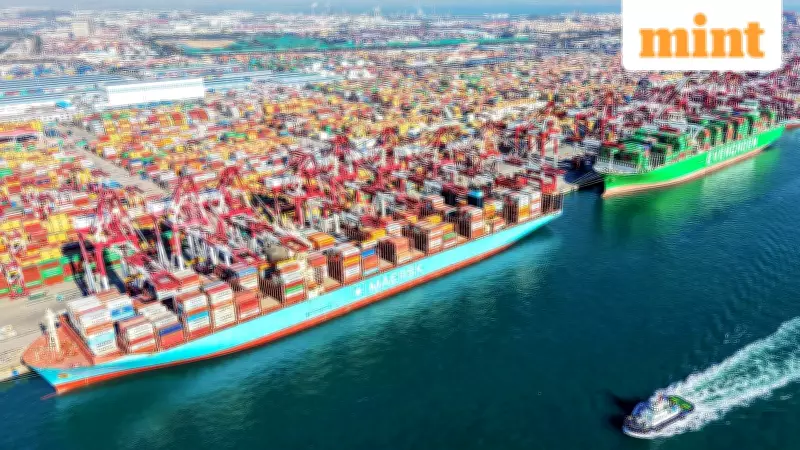
High-quality infrastructure—including modern ports, efficient freight corridors, and strategically located logistics hubs—significantly reduces delivery times and transportation costs. A relatively undervalued currency has further enhanced export competitiveness in international markets.
Perhaps counterintuitively, imports have played a central role in China's export model. The country imports capital goods, advanced machinery, intermediate inputs, and critical technologies at scale, embedding these components into export-oriented manufacturing processes. This approach enables firms to specialize, assemble efficiently, and upgrade technologically over time.
For India, this represents a crucial lesson. While policies such as the Production Linked Incentive scheme and Atmanirbhar Bharat initiative are often interpreted as discouraging imports, China's experience demonstrates that high-quality imports are essential for export competitiveness. Recent rollbacks of quality control orders that created certification hurdles represent positive steps, and improving access to imported inputs will be particularly vital for micro, small, and medium enterprises.
Financial Depth and Export Financing
Export operations are inherently capital-intensive, requiring firms to finance production at scale, manage extended working-capital cycles, hedge various risks, absorb payment delays, and invest in overseas marketing, distribution, and after-sales networks. Consequently, access to domestic finance plays a decisive role in export competitiveness.
China's domestic finance to the private sector stands at approximately 194% of GDP—comparable to Japan (197%) and the United States (201%), and substantially higher than the United Kingdom (113%) and France (108%). This financial depth has enabled Chinese firms to dominate export markets, operate across multiple geographies, withstand tariff shocks, and scale volumes rapidly.
India presents a contrasting scenario, with domestic finance to the private sector at about 50% of GDP. Without easier access to financing, Indian exporters face significant challenges in scaling operations, diversifying markets, and sustaining long-term competitiveness.
Sustainability Considerations and Growth Models
Despite achieving a record trade surplus, concerns persist regarding the sustainability of China's externally reliant growth model. Household consumption accounts for only about 39–40% of GDP, significantly below the global average of over 65%, while investment contributes close to 40%. Domestic consumption has weakened amid slower growth, deflationary pressures, a prolonged property downturn, and declining fertility rates.
India's growth model differs structurally, with private final consumption expenditure contributing roughly 60% of GDP, while investment plays a more moderate role at approximately 30–34%. Thus, while China exemplifies an investment- and export-driven model, India remains predominantly consumption-led.
Exports provide access to vast international demand, but when global conditions become adverse, economies heavily dependent on the external sector face greater vulnerability than those anchored by resilient domestic demand. China's experience offers valuable lessons regarding scale, logistics, and input access—but India should carefully consider avoiding excessive pursuit of export growth at the expense of domestic consumption, a lesson that represents a crucial distinction between the two economic approaches.
The insights from China's tariff resilience demonstrate that while strategic export policies are important, maintaining balanced economic growth that incorporates both international competitiveness and domestic consumption stability represents the most sustainable path forward for emerging economies like India.





