What Can 100 Rupees Buy in London? A Viral Video's Reality Check
A short, playful video shared recently on Instagram by veggiwander has struck a chord with people across India, amassing over three million views. It begins with a simple question: "India ke 100 rupaye ki yahan kya value hai?" (What is the value of 100 rupees here?). This query sets the stage for a quiet reality check on the cost of living in a foreign land, specifically London, one of the world's most expensive cities.
The Experiment: From Hope to Disappointment
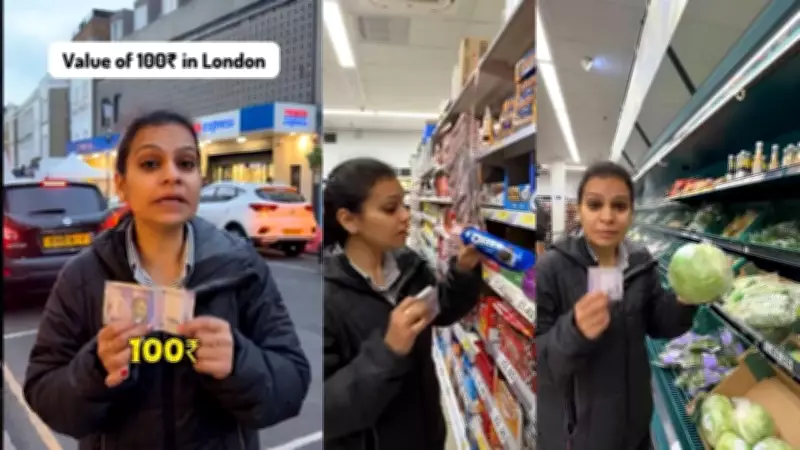
The video features a woman holding a ₹100 note and walking through a supermarket on London's main street. In India, this amount holds decent value, allowing one to buy a quick snack, a cup of tea or coffee, shakes, or even a basic meal or thali in some parts. However, in the UK, the currency translates to roughly £0.80 (pound), setting the scene for a challenging search.
As the woman enters the market, her journey begins with hope. She wonders if ₹100 could get her a simple cheese and onion sandwich, but reality hits hard as the sandwich is priced at £1.50, far beyond her budget. Undeterred, she scans shelves with curiosity, looking for more affordable items.

She finds a basic necessity: a bottle of water. Confident that ₹100 should at least cover a 500 ml bottle, she says, "Pani to shayad khareed hi paungi" (I might at least be able to buy water). Yet, her hope shatters upon seeing the price tag of £1.15, approximately ₹143. "Pani bhi nahi khareed paungi" (I can't even buy water), she remarks, moving away in disbelief.
The Search Continues: More Items, Same Story
Her search doesn't stop there. She picks up a cabbage priced at £0.89—still too expensive. Next, a pack of Oreos catches her eye, but it's priced at £1.65, also out of budget. She reflects, "100 rupaye me na main oreo ka packet bhi nahi le parhi hoon kyunki vo bhi 1.65 pound ka hai" (I can't even buy a packet of Oreos with 100 rupees because it costs 1.65 pounds). Each item she examines tells the same story: ₹100 is simply insufficient in this context.
Finally, her search comes to an end with a small victory. She finds one item within her budget: a small packet of carrots priced at £0.60, around ₹75. With a half-hearted laugh, she says, "Arry yaar. Jo main le sakti hoon, vo to sirf ye gajar ka packet hai jo hai .6 pounds ki to bus yehi le lete hain" (Oh dear, the only thing I can buy is this packet of carrots at 0.6 pounds, so let's just take this).
Significance of the Video: Beyond Currency Conversion
For many Indians, ₹100 is quite valuable for everyday utility. It can cover auto fare, a plate of chaat, idli sambar, other street food, a dozen bananas, or half a kilo of apples. But in London, the same amount is almost negligible in terms of purchasing power. This video highlights not just currency conversion but the broader concepts of purchasing power, cost of living in foreign countries, and the strength of local currency.
It's important to note that salaries in the UK are significantly higher than in India, which balances the cost of living for residents. However, for visitors and travelers, the difference feels stark and eye-opening. The video doesn't rely on dramatic commentary; instead, it simply shows, through one woman's grocery run, how far ₹100 can travel across borders, offering a poignant lesson in global economics.
This viral experiment serves as a reminder of the economic disparities that exist worldwide, sparking conversations about value, affordability, and the realities of international travel.