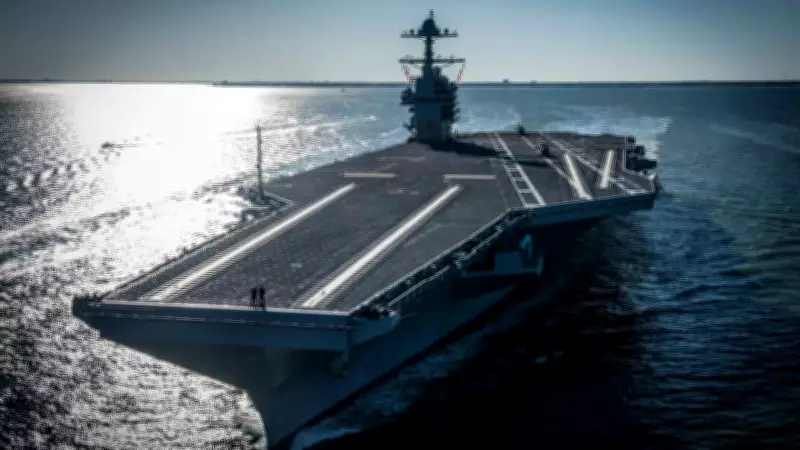
USS Gerald Ford's Premature Departure from Middle East Amid Operational Woes
The USS Gerald R. Ford, the United States Navy's most advanced and costly aircraft carrier, has been compelled to withdraw from its critical Middle East deployment earlier than scheduled. This unexpected exit follows a significant onboard fire incident, which has reignited longstanding debates concerning the vessel's operational preparedness and technical reliability.
Laundry Fire Forces Port Call in Crete
The immediate catalyst for the carrier's redeployment was a fire that erupted within the ship's laundry facilities during operations connected to Iran. According to US Senator Tim Kaine, who detailed the event in a formal letter to Navy Secretary John Phelan, the blaze resulted in injuries to two sailors. Furthermore, over 200 personnel required medical treatment for smoke inhalation. The carrier subsequently docked at a port in Crete for assessment and repairs, as reported by Bloomberg.
Persistent Questions Over $13.2 Billion Warship's Readiness
This incident has cast a spotlight on broader, systemic issues plaguing the Ford-class carrier, which was delivered in May 2017 after considerable delays. A recent Pentagon testing office assessment underscores a critical lack of operational data. The report explicitly states that "insufficient data are available at this time" to definitively evaluate the carrier's combat effectiveness, citing incomplete realistic testing even years post-induction.

Key capability gaps identified include:
- Aircraft launch and recovery system reliability
- Advanced radar performance under duress
- Functionality of weapons elevators
- The ship's capacity to sustain prolonged operations during enemy engagements
The scarcity of comprehensive test data leaves unresolved questions about the carrier's proficiency in detecting, tracking, and intercepting diverse threats such as enemy aircraft, anti-ship missiles, or small attack craft, especially during intense, sustained combat scenarios.
Additionally, while the Navy has formulated solutions for certain combat system deficiencies noted in earlier classified reviews, the Pentagon testing office revealed a significant hurdle: "the fixes still remain largely unfunded."
Chronic Sewage System Failures Plague Deployment
Beyond combat systems, the supercarrier has been dogged by persistent and embarrassing sewage system failures during active duty. The vessel employs a vacuum-based waste system, adapted from cruise ship technology to conserve water. However, this system has proven inadequate for a crew exceeding 4,600 sailors.
Reports from outlets like Gulf News and NPR indicate that the system's narrow pipes frequently clog, leading to repeated vacuum failures. An NPR review of internal emails documented a staggering 205 sewage-related breakdowns within a mere four-day span. Engineering crews were forced to work marathon shifts, up to 19 hours long, to address leaks and overflows.
During its 2025 deployment, the carrier averaged approximately one sewage-related maintenance call per day, according to Navy Times. Earlier investigations, including a 2022 Forbes report, noted that severe blockages necessitated specialized acid flushing procedures, each costing around $400,000, highlighting the recurring and expensive nature of this logistical failure.
Extended Missions Exacerbate Crew Challenges
The carrier's operational tempo has further strained its systems and personnel. The USS Gerald Ford has been at sea for approximately nine months, surpassing the standard seven-month deployment cycle. This extended mission included operations related to Venezuela before its redeployment to the Middle East under orders from US President Donald Trump.
Senator Kaine warned that this prolonged deployment has forced sailors to "improvise with broken equipment and ship support systems," and could potentially become the longest carrier deployment since the conclusion of the Vietnam War.
A Pentagon assessment also flagged logistical shortcomings, noting a shortage of 159 bunks required to adequately accommodate the ship's crew and associated personnel. This berthing deficit "will affect quality of life onboard," a concern expected to intensify with the integration of newer aircraft and drone systems.

Navy Maintains Confidence Amid Scrutiny
Despite these multifaceted challenges, the US Navy has publicly affirmed the carrier's operational capability. Officials state that their evaluations incorporate both testing performance and real-world deployment data. The Navy asserts that operations to date have demonstrated the ship's ability to meet mission requirements while "continuing to improve."
The service has committed to ongoing testing and implementing enhancements based on continuous assessments and operational experience, emphasizing that the evaluation of complex systems like the Ford-class carriers extends well beyond their initial deployment phases.
The premature exit of the USS Gerald Ford from a tense regional theater underscores the intricate balance between deploying cutting-edge military technology and ensuring its thorough, reliable functionality under the pressures of modern geopolitical demands.