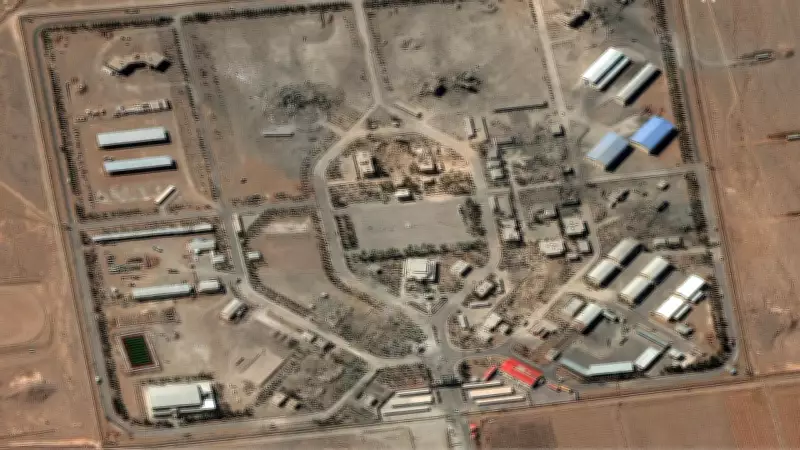
US Forces Reportedly Strike Iran's Strategic Isfahan Province with Heavy Bunker-Buster Bombs
A reported American military strike on Iran's Isfahan province has sharply intensified global attention on one of the Islamic Republic's most vital and sensitive strategic centers. While Iranian authorities have not yet provided comprehensive details regarding the extent of the damage, preliminary media reports indicate that United States forces deployed powerful 2,000-pound bunker-buster bombs to target a large ammunition storage depot located within the Isfahan region.
Former US President Donald Trump amplified the incident's visibility by sharing a dramatic video on his social media platform, which depicted flames engulfing a facility in Isfahan. Concurrently, Iranian state media confirmed that preliminary assessments pointed to strikes in central parts of the country specifically aiming at certain "military sites," though they refrained from disclosing exact locations or naming specific facilities.
Iranian Security Official Confirms Military Facilities Were Hit in Isfahan
The Fars News Agency quoted Akbar Salehi, a security official within the Isfahan governor's office, who stated that initial evaluations indeed suggested some military facilities in the province had been struck. Salehi emphasized that detailed information concerning the scale of the destruction and any potential casualties was not immediately available, leaving the full impact of the attack shrouded in uncertainty.

Why Isfahan Holds Critical Strategic Importance for Iran
Isfahan, historically renowned for its rich cultural heritage and architectural marvels, has evolved into a central nerve center for Iran's national defense apparatus and its controversial nuclear infrastructure. This transformation has occurred against a backdrop of persistent targeting by the United States and Israel, both of which have repeatedly aimed at Iran's key strategic structures over recent years.
The province hosts a dense cluster of critical facilities directly tied to nuclear research, advanced manufacturing, and defense production, making it absolutely central to Iran's long-term security objectives and technological capabilities. At the very core of Isfahan's strategic significance lies its pivotal role within Iran's nuclear program.
Isfahan's Nuclear Facilities House Highly Enriched Uranium
According to a detailed report published earlier this year by the International Atomic Energy Agency (IAEA), the Isfahan nuclear facility is confirmed to house uranium that has been enriched to 60% purity—a level that is alarmingly close to weapons-grade thresholds. Nuclear experts globally warn that such material can be further refined into weapons-grade uranium relatively quickly, which places the Isfahan site squarely at the center of intense international scrutiny and ongoing diplomatic tensions regarding Iran's nuclear ambitions.
Dual Above-Ground and Underground Infrastructure for Protection
The infrastructure spread across Isfahan combines both visible above-ground industrial complexes and heavily fortified underground elements. While extensive parts of the industrial complex are distributed across open terrain and remain observable via commercial satellite imagery, intelligence assessments suggest that more sensitive nuclear materials and critical components are likely stored within a reinforced tunnel network constructed beneath the nearby mountainous regions.
This dual-structure approach reflects a deliberate Iranian effort to balance operational scale and efficiency with the robust protection of its most vital strategic assets. The underground tunnel complex, featuring multiple concealed entry points, is specifically engineered to shield high-value materials from external military threats and persistent surveillance efforts. However, the precise internal layout and current condition of these subterranean facilities remain largely opaque to foreign intelligence, adding layers of uncertainty regarding the site's overall resilience and operational capacity.

Broader Implications for Iran's Defense and Global Stability
Beyond its central role in nuclear activities, Isfahan also contributes significantly to Iran's broader defense manufacturing ecosystem, thereby reinforcing its immense strategic weight within the nation's military-industrial complex. Any substantial disruption to the facilities operating within this region could carry serious implications not only for the trajectory of Iran's nuclear program but also for the integrity of its military supply chains and conventional defense capabilities.
The recent attack on Isfahan starkly underscores the escalating intensity of the prolonged conflict between the United States and Israel on one side and Iran on the other—a confrontation that has now extended perilously into the wider Gulf region. Iran's continued strategic chokehold over the Strait of Hormuz, a critical global artery for energy flows, has already effectively disrupted international shipping lanes, sharply driving up global oil prices and unsettling financial markets worldwide.
This development marks a significant escalation in regional tensions, with potential ramifications for international diplomacy, energy security, and geopolitical stability across the Middle East and beyond.