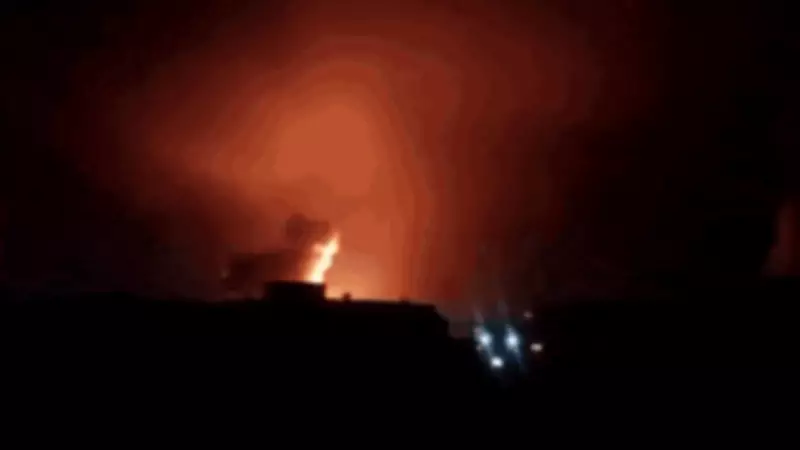
The United States launched retaliatory strikes against Iran on Wednesday after Tehran shot down a US Apache helicopter near the strategic Strait of Hormuz. The attack marked a significant escalation in the ongoing tensions between the two nations, which have been heightened since the beginning of Operation Epic Fury, the US mega military campaign against Iran.
Details of the US Strikes
The US military's Central Command (CENTCOM) confirmed that American forces targeted Iranian air defense systems, ground control stations, and surveillance radar sites in the vicinity of the Strait of Hormuz. The strikes were carried out by fighter jets from the US Air Force and Navy, utilizing precision-guided weapons. The operation was conducted under the direct authority of President Donald Trump, who had earlier warned of retaliation following the downing of the helicopter.
Video footage circulating online appeared to show US strikes hitting an Iranian site, triggering a massive explosion that illuminated the night sky. According to an Al Jazeera report, explosions were heard in the Iranian cities of Jask and Bandar Abbas. The US military emphasized that the strikes were a proportional response to recent attacks on US forces and international commercial ships transiting regional waters.

Iran's Response and Regional Impact
Iranian state media, citing military sources, reported that the Islamic Revolutionary Guard Corps (IRGC) vowed a "decisive response" to what they termed "renewed hostilities by the enemy under the pretext of helicopter crash." Tehran promised retaliation, raising fresh doubts about efforts to secure a permanent ceasefire in the conflict. The war has already disrupted shipping through the Strait of Hormuz, a critical chokepoint for global oil supplies, and pushed up energy prices worldwide.
Missile warning sirens also sounded in Bahrain, home to the US Navy's 5th Fleet, after Iran claimed it had targeted the island nation in response. Iran confirmed attacks near Bandar Abbas and Qeshm Island but did not provide details about the extent of the damage. Iranian Foreign Minister Abbas Araghchi wrote on X: "Will leave no attack or threat unanswered," adding, "Leave our region if you want to be safe."
Background of the Conflict
Earlier, Trump had warned Iran of retaliation after the helicopter was shot down, though he later sought to downplay the incident, stating it was "not a big deal" because the pilots had survived. The downing of the Apache helicopter and the subsequent US strikes further strained a two-month ceasefire that had been in place. The development came a day after Iran and Israel exchanged fire for the first time since the fragile truce took effect. Iranian state television reported that Israeli attacks on Tuesday killed at least two members of the country's air defense units.
Since the US and Israel began striking Iran on February 28, the conflict has shaken the global economy, driven up energy prices, and increased the cost of many essential goods, including food. Efforts to turn the April ceasefire into a permanent peace agreement have so far failed, especially as Israel continues and expands its military operations in Lebanon against the Iran-backed Hezbollah militia.
Global Implications
The escalation has raised concerns about a broader regional war, with the Strait of Hormuz being a vital waterway for oil shipments. Analysts warn that continued hostilities could lead to further disruptions in global energy markets and exacerbate economic instability. The international community has called for restraint, but both sides appear entrenched in their positions.
For ongoing updates, follow the US-Iran conflict live coverage.