

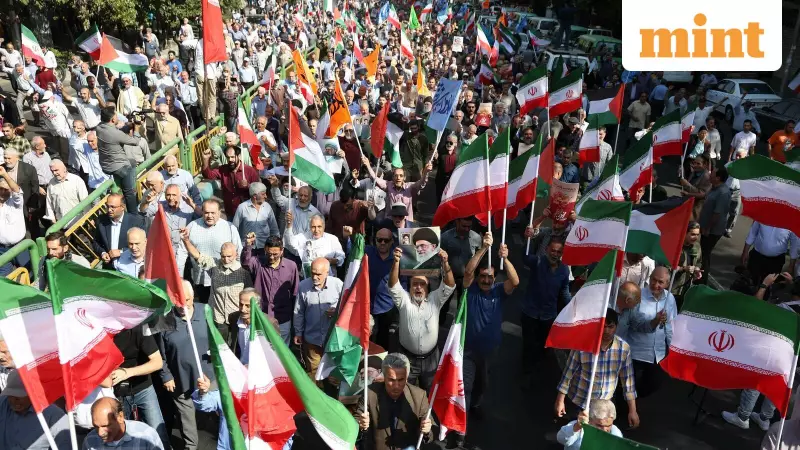
A fresh wave of public discontent has swept across Iran, marking the most significant unrest since the nationwide protests of 2022. Sparked by deep-seated economic despair, the demonstrations highlight a regime struggling to address a paralysing combination of war, financial collapse, and environmental disaster.
The Spark: From Market Strikes to Political Chants
The immediate trigger for the latest turmoil came from an unlikely source. On December 28th, 2025, electronics vendors in Tehran initiated a strike. Their primary grievance was practical: with the Iranian rial in free-fall, importing and selling foreign goods had become nearly impossible. This localised action quickly ignited a broader movement.
Merchants in Tehran's Grand Bazaar, a traditional barometer of political sentiment, soon joined the strike. The unrest rapidly evolved from economic complaints to overt political defiance. Street protests erupted in Tehran and spread to major urban centres like Isfahan and Shiraz. Chants of "Death to the dictator" echoed, signalling frustration that extended far beyond currency exchange rates. In one southern provincial town, crowds attempted to storm a municipal building.

By December 31st, the government's response was to order the closure of schools and offices across 21 of Iran's 31 provinces. Officials cited an energy conservation need during a cold snap, but many Iranians interpreted it as a tactic to prevent larger gatherings and keep potential protesters at home.
A Nation Boiling Over: The Roots of Rage
The current protests, while involving thousands rather than the millions seen in 2009, are the largest since the 2022 upheaval following the death of Mahsa Amini. The underlying causes are multifaceted and severe.
The Iranian rial has lost over 40% of its value since June 2025, when a 12-day conflict with Israel occurred. It recently plunged to a historic low of 1.4 million to the US dollar. Inflation is raging above 40%, and despite a near-doubling of the minimum wage over two years, it equates to barely $2 per day. Chronic energy shortages cause rolling blackouts, and President Masoud Pezeshkian has warned that parts of Tehran might need evacuation due to critically dwindling water supplies.
These are not new grievances. Similar issues fuelled major protests in 2017 and 2019, suggesting Iran exists in a state of perpetual ferment, with significant eruptions every few years.
Paralysed Politics and the Illusion of Reform
President Masoud Pezeshkian, elected in July 2024 on promises of reform, finds his hands tied. Ultimate power rests with 86-year-old Supreme Leader Ayatollah Ali Khamenei, who remains resistant to fundamental change. The regime has made superficial concessions, like relaxing hijab enforcement and promoting pre-Islamic nationalism with billboards of ancient heroes. However, these measures have failed to address the core issue: a rapidly declining quality of life for most citizens.
Pezeshkian's reshuffling of economic officials appears symbolic. On December 29th, he replaced the central bank governor with Abdolnaser Hemmati, an economist who was himself impeached as economy minister in March 2025 over high inflation. Critics dismiss such moves as rearranging deckchairs on the Titanic.
The protest movement itself lacks the organisation, clear leadership, and elite fractures typically needed to topple a regime. Most Iranians, however unhappy, remain at home. The security apparatus has cracked down in smaller towns, resulting in several deaths and over 100 arrests, but has avoided major confrontations in large cities for now.
The Wild Cards: Netanyahu and Trump
Two external factors could unpredictably reshape this crisis. The first is Israeli Prime Minister Binyamin Netanyahu, who is reportedly keen on launching new air strikes against Iran's rebuilding ballistic-missile programme. This was a key topic during his meeting with Donald Trump at Mar-a-Lago on December 29th.

The second wild card is the potential for American involvement. On January 2nd, 2026, former President Trump issued a stark warning to Iran on social media, stating, "If Iran [shoots] and violently kills peaceful protesters... the United States of America will come to their rescue. We are locked and loaded and ready to go."
Given Trump's history—assassinating Iranian General Qasem Soleimani in his first term and bombing nuclear facilities in his second—the regime has reason to take the threat seriously. However, Iran has already killed protesters. Should demonstrations escalate and the crackdown intensify, the world will watch to see if Trump's bluster translates into action, and what catastrophic consequences that might entail.
For now, Iran remains on edge, caught between internal decay and the looming spectre of external intervention, with its people paying the heaviest price.





